Evangelical Power in the American Republic
By Aslam Abdullah
May/Jun 26
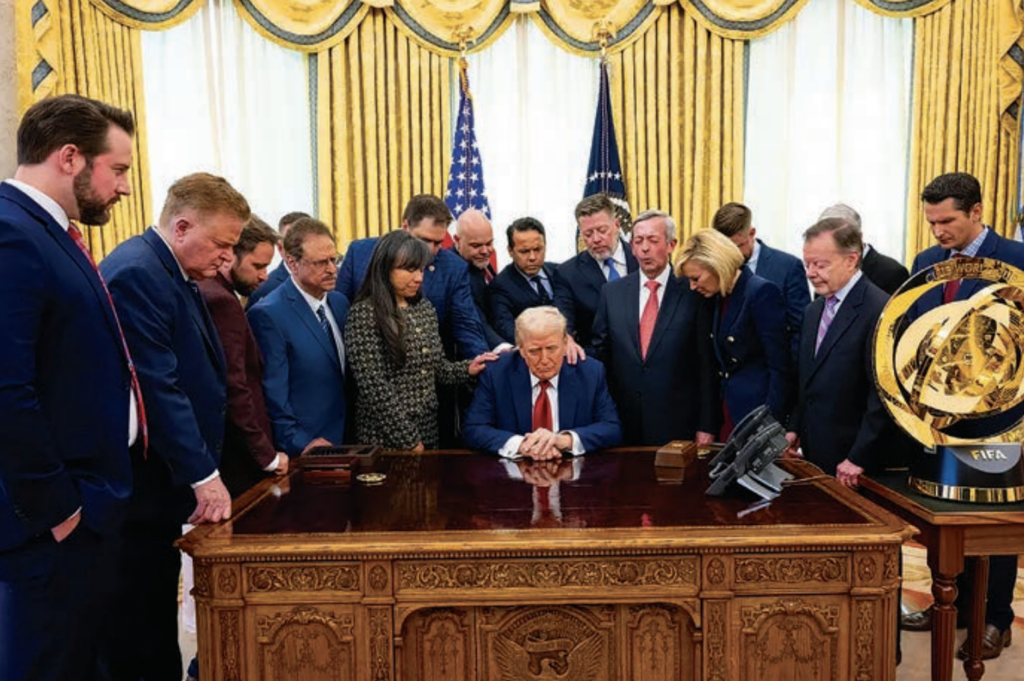
There is a particular American image — half-whimsical, half-mythic — of a president bowing his head while a preacher’s hand rests gently upon his shoulder. The room is often the Oval Office. The prayer is earnest, the moment solemn. It is a tableau repeated across decades: revivalist fervor meeting executive authority.
The story of evangelical influence in the United States is not merely about policy; it is about proximity to power, to the conscience of presidents, to the machinery of law, and to the anxieties of a nation perpetually negotiating for its very soul.
In the 19th century, long before political action committees and White House advisory councils, evangelical Protestantism functioned as America’s moral compass. The sermons of revivalists like Charles Grandison Finney and Dwight L. Moody did not draft legislation, but they shaped the republic’s moral grammar. The 19th and early-20th century temperance movement, the abolitionist inheritance, and the language of sin and redemption all entered public discourse not as partisan slogans but as spiritual imperatives.
Evangelicals and the Presidency
Presidents such as Theodore Roosevelt governed in a nation whose moral imagination had been baptized by Protestant revivalism. Even expansionist rhetoric often carried the undertones of providential mission. Evangelical influence in this era was not institutional. It was atmospheric. It shaped what Americans believed was virtuous, necessary, and divinely sanctioned.
If evangelicalism once conditioned the air, it has since re-entered the room. No figure embodied this transition more than Billy Graham. Tall, composed, and resonant in voice, Graham became something unprecedented: a spiritual confidant to presidents. From Dwight D. Eisenhower to Richard Nixon, Graham moved between revival tents and the White House. He prayed at inaugurations, counseled in crises, and framed the Cold War as not merely geopolitical but spiritual — Christian capitalism versus atheistic communism. Under Lyndon B. Johnson, he offered solace during the moral upheavals of the 1960s.
Graham’s influence was rarely legislative; it was symbolic, pastoral, legitimizing. He helped normalize the idea that a president should publicly profess faith and seek evangelical blessing. The pulpit had found the presidency — not as an adversary, but as a partner.
The 1970s shattered the old Protestant consensus. Supreme Court rulings, cultural revolutions, sexual liberation, and abortion law unsettled many evangelicals who had once remained politically detached. Into this disquiet stepped Jerry Falwell. With the founding of the Moral Majority in 1979, Falwell transformed evangelical concern into electoral machinery. The pulpit no longer whispered into the ear of power; it mobilized voters. His alliance with Ronald Reagan marked a decisive shift. Reagan’s rhetoric — affirming faith, opposing abortion, invoking millenarian language — resonated deeply with evangelical voters. The relationship was mutually beneficial: evangelicals delivered turnout; the administration signaled allegiance to “family values.”
Parallel to Falwell’s organizing efforts was the media empire of Pat Robertson whose Christian Broadcasting Network blurred the boundary between sermon and political commentary. Television became an altar of political theology. And then came James Dobson, founder of Focus on the Family, whose influence extended deeply into Republican administrations, particularly those of George H. W. Bush and later George W. Bush. Dobson shaped debates over marriage, education, and judicial nominations, becoming less a preacher and more an architect of policy boundaries. Evangelical influence had matured into institutional power.
With George W. Bush, evangelical proximity to power reached an intimate apex. Bush openly described himself as “born again.” His administration created the Faith-Based and Community Initiatives Office, integrating religious organizations into federal social services. Evangelical leaders were not merely visitors; they were consultants and stakeholders. Issues such as stem-cell research, marriage amendments, and religious liberty bore unmistakable evangelical fingerprints. Foreign policy, too, reflected theological sympathies. Strong support for Israel aligned with evangelical eschatological and biblical commitments. The alliance was less about symbolism and more about tangible outcomes.
The rise of Donald Trump introduced a paradox. Trump was not a traditional evangelical in comportment or biography. Yet white evangelical voters supported him at historic levels. Why? The answer lies in strategic reciprocity. Evangelical leaders such as Franklin Graham, Paula White, and Robert Jeffress framed the 2016 election as a civilizational competition. In return for unwavering electoral loyalty, the administration delivered conservative Supreme Court appointments; the relocation of the U.S. embassy to Jerusalem; the expansion of religious liberty protections; and restrictive abortion policies.
The alliance was pragmatic rather than pastoral. It marked the transformation of evangelical influence into disciplined political bargaining.
Across these eras, evangelical influence has flowed through multiple channels: personal spiritual counsel (the Graham model); electoral mobilization (the Falwell model); media ecosystems (the Robertson model); policy advisory access (the Dobson model); judicial influence through nomination battles; and foreign policy alignment rooted in biblical interpretation.
The evolution is unmistakable: from moral atmosphere to organized bloc, from sermon to strategy.
What Are the Consequences?
Evangelical influence has been most visible in abortion jurisprudence, marriage and LGBTQ+ policy debates, religious liberty law, Supreme Court nominations, U.S.–Israel foreign policy, education policy, and school prayer controversies. These are not peripheral issues. They sit at the crossroads of identity, morality, and constitutional interpretation.
Yet evangelical influence has never been monolithic. It contains tensions: between prophetic critique and political compromise, between moral absolutism and pragmatic alliance. Some leaders sought to shepherd the nation’s conscience. Others sought to secure policy victories. Some emphasized spiritual renewal; others pursued cultural defense. What unites them is not uniform ideology but a conviction that the American republic remains morally unique — that faith, when organized, can shape law.
What Does the Future Hold?
The American experiment has always wrestled with the question: Is it a secular state animated by private faith, or a covenantal nation guided by public theology? Evangelical leaders have answered, across generations, that faith must not retreat to the sanctuary. From revival tents to White House corridors, they have sought to bend the moral arc of governance toward their understanding of divine order. Their influence has waxed and waned. It has been pastoral, electoral, institutional, and strategic. But it has never disappeared. The pulpit and the presidency remain in dialogue — sometimes harmonious, sometimes strained — each aware that in America, power rarely moves far from belief.
Aslam Abdullah, Ph.D., is a Resident Scholar at Islamicity.com.
Want more like this? Subscribe to the Islamic Horizons magazine and support authentic journalism by Muslims for Muslims.