Granting Palestinians the Power to Narrate
By Monia Mazigh
Sept/Oct 26
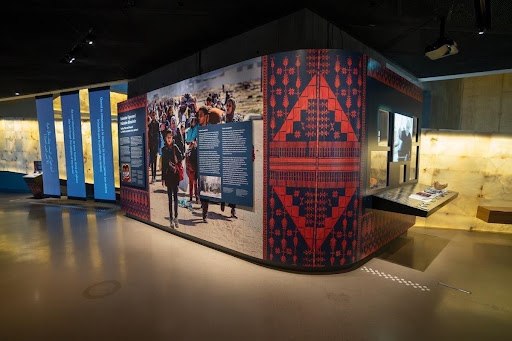
Winnipeg’s Canadian Museum of Human Rights (CMHR) sparked discourse among media outlets and politicians following the launch of its exhibition, “Palestine Uprooted: Nakba Past and Present.”
Some Canadians saw this exhibition – which is open through 2028 – as a glimmer of hope for healing the lingering wounds inflicted by the Canadian settler-colonial model on its own Indigenous populations, or as an acknowledgement of Canada’s Truth and Reconciliation Commission (2008-15) and the 2021 United Nations Declaration on the Rights of Indigenous Peoples Act.
Some believed this exhibition would serve as an initial step demonstrating the nation’s dedication to informing Canadians about the historical and contemporary abuses associated with the forced displacement and dispossession of Palestinians by Israel. The exhibition, it would be assumed, would serve two purposes: educate the public and recognize Palestinian sufferings represented by the Nakba.
However, some politicians, such as the Minister of Canadian Identity and Culture Marc Miller, and some sections of Canadian media continue to defend the indefensible by equating the narrative of Indigenous Palestinians with the narratives of the settler aggressors. Today Canadian Palestinians who lived through the Nakba have the right to tell their stories without interference from those who expelled them or from politicians or special interest groups. Why are there still attempts to eliminate the narrative account of dispossession that scores of thousands of Palestinians and their forebears faced?
Palestinian American academic Edward Said, in his seminal 1993 book, Culture and Imperialism, wrote, “The power to narrate, or to block other narratives from forming and emerging, is very important to culture and imperialism, and constitutes one of the main connections between them.”
And as a direct result of the Nakba, many Palestinians ended up residing in Canada after being driven off of their homeland by armed Israeli factions and aggressively warned against returning to their homes.
The CMHR exhibition, therefore, has merit as a piece of Canadian heritage. The stories of Palestinian Canadians are intertwined with the stories of other communities who found refuge on Canadian soil after war, genocide, or natural disasters in their homeland.
Why is it then, that when Palestinian Canadians seek to describe their dispossession, forced exile, or lived tragedies, certain groups attempt to silence them or assert that the exhibit is biased because it doesn’t present the “other side of the story”?
Has there ever been a display describing the Holodomor, the Soviet state-enforced famine in Ukraine in the 1930s that resulted in the deaths of millions, that concurrently provided official Soviet narratives defending Stalin’s actions? Or would there be a poster in the same exhibition indicating that Russians believe the famine was an unintended consequence of severe, expansive economic policies, industrial growth, and/or poor agricultural management that impacted other ethnic groups?
When people tell their story, they hold artifacts in their hands, emotions in their hearts, show pictures in their photo albums, and bring out clothing from their old chest boxes as tears roll down their cheeks. All this makes their memories remain alive and real – like their grandmother’s dresses, embroideries received as gifts, and artwork religiously preserved over the years. These are all ways to remember childhood scents, their homes and their ancestors, and of course, their homeland. This is a way to tell their truths.
This is exactly what the CMHR exhibition intends to do in part by showing pictures of Palestinians walking after they have been dispossessed and expelled from their homes displaying the sorrow and despair in their faces. The exhibition highlights children, women, and old men holding what is left from their home: ancient keys half broken, half damaged by the rust and the passage of time, belonging to homes they still dream of going back to.
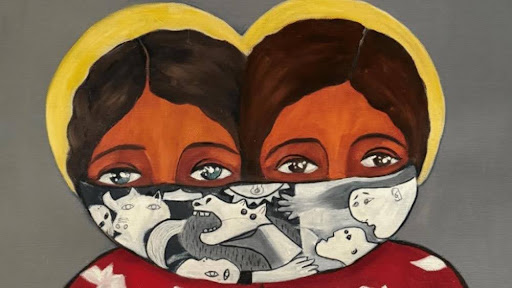
But the exhibition isn’t only about victimization of Palestinians; it is about their dreams, their resistance, and their resilience to build over the years through tatreez embroidery representing olives, wheat, fish, dates, native flowers and plants, wedding ceremonies, and religious scenes. Through contemporary painting, Palestinian artists represent the feeling of balancing between war and tragedy, between hope and despair.
The exhibition also features yellowed pieces of paper kept in old suitcases like birth certificates, more documented proof that Palestinians belong to Palestine, even if that isn’t officially recognized in their current passports. It is also the certificate of registration of a house that once belonged to your great-grandfather, but now only exists on paper. The actual house itself is still in place, but now in the hands of Israeli settlers that stole it during the Nakba.
Museums shouldn’t be places of political correctness or closets for hiding skeletons. Museums should be places where strong emotions can surface even when these emotions will make some others feel uncomfortable. Indeed, museums should make us all feel uncomfortable so we can wake up and act to stop the killings, to prevent another genocide, and to stop all forms of complicity in any form of injustice.
The museum informs that 186 dignitaries from 46 countries have visited the CMHR in the past two years, all with their own points of view. “This [exhibit] is about our shared humanity and really, sharing one community’s experiences,” CMHR CEO Isha Khan told CBC. “It doesn’t negate that Jewish people have faced displacement and been impacted by that, or certainly that they’re experiencing record levels of antisemitism today.”
“It helps us understand what the impacts of forced displacement are, and Palestinian Canadian stories belong in our collective memory, and that’s what museums like ours do,” said Khan.
Monia Mazigh, PhD, writes in English and French about politics, national security, Muslim women, and literature. She is a prize-winning novelist, essayist, and a human rights activist.
“Palestine Uprooted: Nakba Past and Present” Exhibition will be featured from June 27, 2026 to Nov. 30, 2028 at the Canadian Museum for Human Rights in Winnipeg.
Want more like this? Subscribe to the Islamic Horizons magazine and support authentic journalism by Muslims for Muslims.