Anti-Palestine Censorship and the Fight for the First Amendment
By Sandra Whitehead
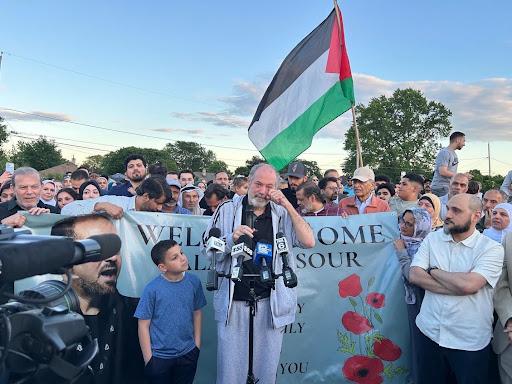
Hundreds gathered spontaneously at sunset on June 18 on the grounds of Wisconsin’s largest mosque awaiting the arrival of beloved community leader Salah Sarsour. That morning, U.S. District Judge James P. Hanlon of the Southern District of Indiana ordered the immediate release of the president of the Islamic Society of Milwaukee (ISM) from an Indiana jail where he had been held by U.S. Immigration and Customs Enforcement (ICE) for 81 days.
In his 29-page order, Hanlon noted Sarsour’s First Amendment claims are “substantial, which could render his detention unlawful… Sarsour’s speech in support of Palestinian rights is protected by the First Amendment.”
“It appears to be the latest case in which the administration has sought to deport someone who was active in pro-Palestinian causes, ” The New York Times reported just after a dozen armed ICE agents ambushed and detained Sarsour the morning of March 30.
Secretary of State Marco Rubio deemed Sarsour to be “a threat to the U.S. foreign policy interest of combating antisemitism” in 2025. “There’s a special provision in the immigration laws that says if the U.S. Secretary of State determines a person’s continued presence in this country would have adverse foreign policy consequences, then they are deportable,” Sarsour’s immigration attorney Patrick Taurel explained. “Just a swipe of a pen from Marco Rubio and an otherwise legal permanent resident can be rendered deportable. It’s a really shocking statute.”
A Hero’s Welcome
When a black SUV with a Palestinian flag hoisted through the sunroof crossed the mosque’s parking lot, drummers pounded an Arabic beat, and an emotional homecoming celebration began. Sarsour stepped out, 35 lbs lighter than before he was arrested. “I am back, Alhamdulillah [all praise be to God],” he declared. Smiling through tears, he added, “I’m so happy. I can’t say in words how I feel… I am back to serve our community. We have a lot of projects to do for the future, for our children.”
It sounds like a happy ending, but it’s not the end of this story. Sarsour, 53, is in a battle for the life he has known for more than three decades, a battle that has implications for every person living in America. “What’s at stake here is not just whether this good man can stay here, but whether people can speak freely in this country without fear of unlawful retribution,” said Taurel at a post-hearing press conference in mid-September.
At the time of this writing, the saga of the arrest, detention, release, and deportation hearing of an important Muslim leader in a mid-sized Midwest American city and a national leader in the fight for Palestinian human rights is still unfolding. A ruling in Sarsour’s deportation case is expected by Sept. 30. If the judge finds he is “removable,” the next step will be to apply for relief from deportation, like asylum for example, Taurel said.
Meanwhile, Sarsour wasted no time in jumping back into his leadership roles, showing up at community events and personal celebrations.
“His absence clearly had an impact,” ISM Director Othman Atta told Islamic Horizons. “Salah is someone who’s very hands-on and who takes his role as the elected president of ISM very seriously. Anytime anyone has a request, he doesn’t pass it on. He meets with people himself, whether helping them resolve business or family disputes or addressing community issues. . . It’s been hard to fill the void.”
The next day, Sarsour spoke at a press conference at ISM during which he thanked his family, his legal team, and all who called for his release.
Public Outcry, Popular Support
Almost immediately upon his arrest, public outcry manifested in a groundswell of support that included widespread advocacy by community organizations, resolutions from local governments, and statements from members of Congress.
A coalition of Jewish Americans from the Midwest from across political and denominational spectrums organized a rally in June in front of the jail holding Sarsour. More than 150 Muslims, Christians, Jews, elected officials, immigrant rights advocates, and others – many who had traveled hundreds of miles to be there – participated.
Later, Sarsour joined the Wisconsin Muslim Civic Alliance (WMCA) July 3 to celebrate the opening of its new office. “Salah symbolizes the whole purpose of this organization,” said WMCA board president Sheila Badwan. “We advocated for him and for the resolutions passed for him [by the Milwaukee County Board of Supervisors and the City of Milwaukee]. We wrote letters of support for him. To have him with us at our celebration was so meaningful!”
On July 22, the eve of the first of his four-day deportation hearing (which actually spread from late July to mid-September), Sarsour celebrated a fellow ISM shura member’s daughter’s high school graduation at a community picnic. In August, he spoke at Hanan Relief Group’s annual Nasef Scholarship Dinner, urging the local Muslim community to give generously to refugee students. His consistent, daily presence in Milwaukee’s Muslim community is tangible, Atta said.
But Sarsour’s case also impacts a wider sphere, he noted. Leveraging his high-profile deportation case, Sarsour is speaking on major media platforms about its First Amendment implications. In July, he spoke on Democracy Now! about federal authorities targeting pro-Palestinian advocacy. He authored an opinion article July 20 for USA Today about the weaponization of immigration enforcement. He accepted the Council on American-Islamic Relations “Courage Under Fire” award in mid-September, delivering an address on civil rights and steadfastness. He is scheduled to headline a panel at the Busboys and Poets D.C. conference in Washington, D.C. on Sept. 21 titled Muting a Genocide: Salah Sarsour and the Fight for Free Speech.
“The fact that a person who’s been a law-abiding citizen of this country for many years and the elected president of Wisconsin’s largest Islamic organization would be specifically targeted by the government is very troubling,” Atta said. “We believe it is a message from elements of the government we know very clearly have the goal of censoring the Palestinian narrative and limiting any effective Palestinian advocacy.”
Atta continued, “Regardless of the threats and pressure, we will continue to be advocates for Palestinian human and political rights, and for Muslim rights in this country.”
Sandra Whitehead is an author, educator, and journalist in Milwaukee. She is also the lead reporter for the Wisconsin Muslim Journal.
Want more like this? Subscribe to the Islamic Horizons magazine and support authentic journalism by Muslims for Muslims.