The Crossroads of Culture
By Maryam Moss
Sept/Oct 26
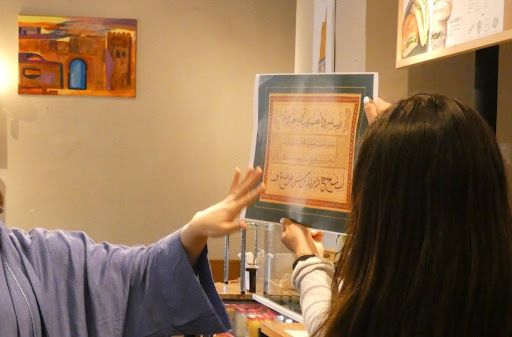
Arabic calligraphy takes a familiar path – developing as a practical solution and culminating in both informal expression and art in its own right. However, it stands apart from other crafts due to a basic, yet sustained, function. Arabic calligraphy beautifies, yet its abstract form – without iconography – preserves the originality and integrity of scripture.
Its origins can be traced to Prophet Muhammad’s (salla Allahu ‘alayhi wa sallam) lifetime when scribes first copied the revelation onto parchment, bones, and wood. Later, during the rule of the first caliphs, manuscripts bearing chapters and verses of the Quran were collected, verified, and standardized into a complete text. Soon after, numerous other copies were distributed throughout the growing Islamic empire. The earliest known script used was known as Kufic, named after the historic city of Kufa in Iraq. Its bold font and well-defined strokes made Arabic characters easier to read.
Functional and Artistic Versatility
Kufic became the standard font for transcribing the Quran and predated the more intricate, decorative styles used by trained artisans under the later Umayyad, Abbasid, and Ottoman dynasties. Several new styles, including naskh, thuluth, diwani, rayhani, and others emerged between the first few centuries of Islam into the 1800s and beyond.
In every case, the unique visual and structural qualities of each style supported recordkeeping, architecture, and personal craftsmanship throughout the Muslim world.
As stated by UNESCO, “the fluidity of Arabic script offers infinite possibilities, even within a single word, as letters can be stretched and transformed in numerous ways to create different motifs.”
Manuscripts, which could be lavishly illustrated with ink and penned in different calligraphic fonts yet remain portable, were valuable to nomadic cultures in Arabia.
Other cultures like the Ottoman empire fused native art and social custom with European traditions.
Renowned calligrapher Mustafa Rakim was famous for manipulating the curvature and elongated lines in letters like the ain ع and alif ا to hint at animate forms — coinciding with the expressionism and post-impressionism of the thriving art scene in Europe. Like Rakim, these 18th and 19th century European artists did not copy from previous sources but used brushstroke, shape, and dimension to symbolize realities.
As a result, an expressive quality would come to define calligraphy during the Ottoman Empire where the cursive diwani and thuluth styles were popular.
Calligraphy and Community in Detroit
At a May 3 calligraphy workshop in Kitaab Cafe and Bookstore in Detroit, a cohort of Muslim women were introduced to the fundamentals of the artistic tradition. The event was hosted by Tadabbur, a Michigan-based nonprofit that offers a variety of social and educational programs to help Muslim women rediscover Islamic scholarship and sisterhood.
Tadabbur was joined by artist Zahra Abdulameer who guided participants through each meticulous stage – from individual letter prototypes to replicating the luscious, controlled strokes of the naskh style in ink.
For some attending, the experience was entirely new. For others, it evoked family histories such as the art of henna that their mothers and grandmothers used to practice, or the intricate handwriting systems found across cultures.
As the women found joy and traces of heritage in their craft, Abdulameer enriched the experience with a technical explanation.
She explained that even the letter alif ا – often envisioned as linear – isn’t just a straight line, but assumes a dart shape. All Arabic characters follow a topography of nuqtals ه ه ه – dots that denote the size, width, and inflections of each stroke in a letter’s formation.
One participant later reflected on this clever principle. “Every letter is in [stages] – in three portions – and that’s how you keep the shape and integrity of the letters,” she said.
Calligraphy and Artistic Evolution Under Islamic Empire
As the spread of Islam took this new form of calligraphy beyond Arabia, it became a point of cross-cultural intellectual exchange. By roughly 1250 AD, Islam had reached China where Arabic calligraphy – interpreted through ancient Chinese tradition – acquired new philosophical value.
Yin and Yang – two opposing forces in Chinese cosmology – relate to the Quran’s mention of complementary pairs: “Glory to God, Who created in pairs all things that the earth produces, as well as their own (human) kind and (other) things of which they have no knowledge” (36:36).
The angle of the hand, the pattern created by each set of nuqtal dots, and the degree of pressure to be exerted on the pen all become a way to replicate natural harmonies in human invention.
As renowned calligrapher Haji Noor Deen expressed at a workshop hosted in 2025 at the Islamic Association of Greater Detroit,“Calligraphy in the Chinese style,” Arabic calligraphy found agreement with the universal harmonies of Chinese thought.
Yin and Yang, two elemental forces that correspond with each other in nature, align with the principles of Arabic calligraphy, in which balance is key to achieving the ideal shape for a letter. In most styles, the width of any stroke follows a gradient – thickening or narrowing from bottom up or top-down along the flow of ink. Without this principle, letters would lack the elegance and symphony that give calligraphy its prestige.
Calligraphy as Function
In China today, calligraphy adorns domestic and religious objects including Quran stands, furniture, and mosque entryways, but also becomes a symbol of belonging and hospitality. The meticulous letter detail along a restaurant isn’t only meant to be admired but also identifies a Muslim-owned establishment.
The art of Islamic calligraphy – first developed as a standardized writing system to distribute mushafs (physical copies of the Quran)– has changed many hands throughout the Muslim world from sultans to unknown artists. Now, some self-taught calligraphers are trading reed pens for Apple pencils, affirming a centuries-old theme of original invention and adaptation.
Others, formally trained in a style, are ambassadors of the earliest calligraphic schools.
In most cases, there is a fusion of both traditional and modern – proof that the line between these is rarely ever definite.
By the end of the workshop at Kitaab Cafe in Detroit, several Bismillah Ar-rahman Ar-Rahims had been reproduced in ink. Bearing the qualities of formal style, yet not without a personal touch, the finished pieces were ready for participants to take home and retell the story of their making.
Maryam Moss is an undergraduate pursuing a major in Journalism and Media Studies and a minor in International Relations at Oakland University.
Want more like this? Subscribe to the Islamic Horizons magazine and support authentic journalism by Muslims for Muslims.