Food of People of the Book No Longer Resembles Their Historical Diets
By Mohammad Abdullah
Sept/Oct 26
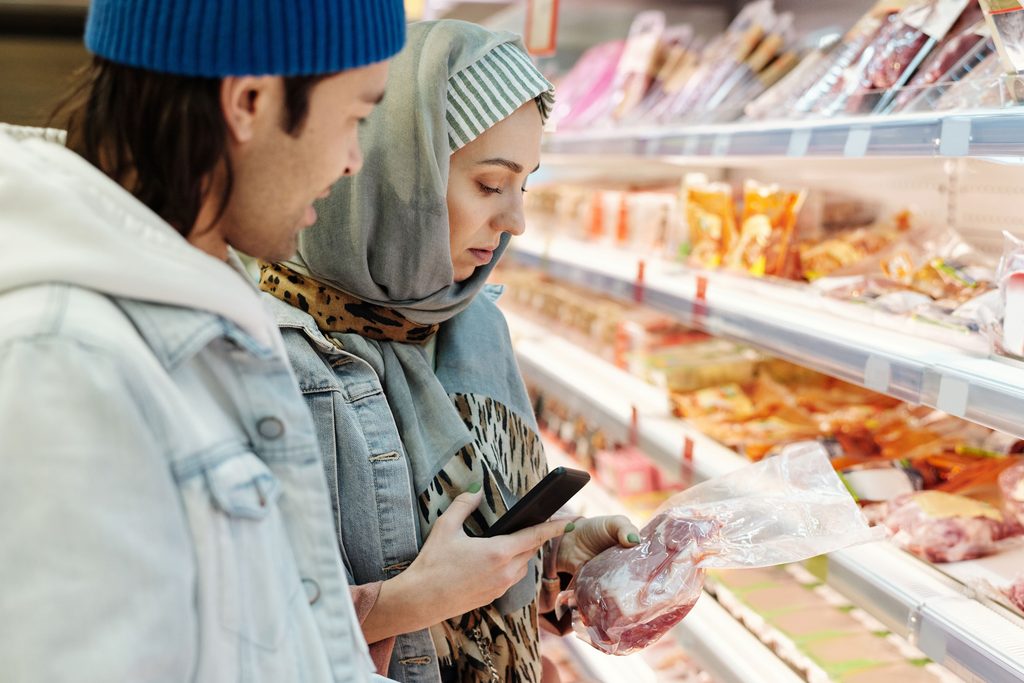
Jews and Christians, as the “People of the Book,” hold a special status in Islam due to shared faith in the God of Abraham, Moses, and Jesus (‘alayhum as salaam). The Quran states, “This day are (all) things good and pure made lawful unto you. The food of the People of the Book is lawful unto you, and yours is lawful unto them” (5:5).
Some Islamic scholars consider that “food” in this verse refers to meat of animals slaughtered by the People of the Book (Zabih Ahle Kitab). Using this analogy, some Muslims consider it is permissible to eat. Others disagree and even caution the possibility of their meat being mixed with pork, lard, or alcohol – now a common practice.
Throughout history, meat has been central to human culture and communal identity. In Judaism and Islam, meat represents much more than mere substance. Its consumption is governed by divine laws that regulate animal selection, humane treatment, purity, and goodness.
The authority to interpret 5:5 lies exclusively with Fiqh scholars. However, in modern times, along with religious knowledge, we also need the knowledge of today’s industrial slaughterhouse systems to understand the difference between general commercial meat, certified-kosher and halal meats, and the problem of “economically motivated adulteration” (EMA).
The Quran states, “O’ Messengers, eat from good things [made lawful as sustenance] and do righteous deeds” (23:51). The command to be righteous in deeds refers to the command to eat from what is halal (lawful), especially meat. Eating something that isn’t halal can block righteous deeds. Ultimately, eating halal and tayyab (wholesome/pure) food is especially important because what we consume becomes part of the body and can affect us physically and spiritually.
Understanding Today’s Meat Market
During Prophets Moses and Muhammad’s times, cattle, sheep, and goats grazed on pastures, chickens pecked on grassy ground, eating grains and insects. The local butchers slaughtered animals by cutting their throat with a sharp knife, an action that ensures the animal experiences a swift loss of consciousness by anemia of the brain caused by the simultaneous and instantaneous severance of the carotid arteries and jugular veins.
Today, meat products come from the global marketplace. As globalization continues, food producing companies compete by producing more, faster, and cheaper. Companies use procedures such as vertical integrated farming system; concentrated animal feeding operations where rendered animal by-products are fed back to animals; and the use of pre-slaughter stunning methods and techniques that help fast moving production lines run un-interrupted.
Consumers must also be aware of fillers, extenders, and blenders, which are functional ingredients for improving texture, enhancing moisture retention, reducing production costs, and maintaining consistent batch sizes.
Because pork is significantly cheaper to produce than beef, blending the two allows stretching the meat budget while retaining essential moisture and flavor. The United States Department of Agriculture (USDA) allows adding 10% of pork to beef, but it must be clearly labeled as a mixed-meat product, and both declared in the ingredients list in order of predominance. However, such labelling is not required of neighbors, friends, and eateries.
Pre-Slaughter Stunning
To keep animal slaughtering lines running uninterrupted, plants use pre-slaughter stunning methods required under the Humane Methods of Slaughter Act (1958). In the U.S. and Canada, the most common methods are the Pneumatic Captive-Bolt (Cattle), the Electrical or Pneumatic Captive-Bolt (Sheep/Goats), or simply Electrical or Gas stunning (Poultry). Today, cattle slaughter lines run up to 400 cattle per hour. In February, the USDA proposed allowing young chicken slaughter lines to operate at up to 170 birds per minute, and turkey lines up to 60 birds per minute.
Exposing animals, especially poultry, to electrical current can sometimes stop the heart directly, or cause lethal electrocution if voltage levels are too high. In high-volume industrial meat production, stunning is intended to induce unconsciousness rather than death, but accidental fatalities do happen. For example, a Canadian Food Inspection Agency funded study found that prolonged exposure to gas mixtures designed to induce unconsciousness leads to irreversible stunning and eventually death.
In Europe, Controlled Atmosphere Stunning of poultry slaughter is favored because birds are often stunned in their transport crates. The regulation requires strict, legally-binding guidelines for all stages of poultry processing including stunning and bleeding during which plant personnel must check that the stunning method has been successful on a continuous basis before the birds are bled.
Researchers at the National Center for Biotechnology Information outlined their observations regarding stunning methods to weigh their compatibility with halal requirements, concluding, “It is difficult to be sure if a stunning method, reversible or non-reversible, works consistently and effectively at all the times and under all conditions.”
From the Islamic perspective, pre-slaughter stunning must not kill the animals because God forbids consuming maytah, the meat of an animal that dies before being properly slaughtered or hunted (5:3).
Bleeding
In traditional meat plants, each animal is shackled by the hind legs after stunning, hoisted above the ground, and placed on an overhead moving rail and bled. The bleeding technique for cattle is called vertical cut when the sticking knife is inserted just above the breastbone pointed towards the head and a main blood vessel is cut. The trachea and esophagus are not cut. Sheep and goat are bled using the chest stick method, when the knife is inserted at the depression in front of the breastbone and directed upward towards the tail. This severs the major blood vessels arising from the heart.
In poultry slaughter plants, chickens are hung upside down by their legs on a moving shackle line. They typically pass through an electrified water pan to stun them, followed by automatic sharp rotary blades that slit the neck (ventral cut) to sever major blood vessels. But individual birds react differently, and strong electric current death can happen before the neck incision for bleeding.
Clearly, modern industrial methods have fundamentally changed the nature of slaughter. Commercial meat processing no longer resembles the historic, traditional methods practiced by the People of the Book.
Can Muslims Eat the Food of the People of the Book?
Dining with non-Muslim colleagues, neighbors, and friends and eating vegetarian or fish-based dishes is widely practiced and encouraged for building community. However, for meat to be considered halal, the animal must be a permissible type and slaughtered according to the Islamic requirements.
Notably, 5:5 grants permission only for “good/pure” (tayyibat) food and not a blanket approval for just any kind of food. Since pork is expressly defined as forbidden and inherently impure in both the Quran (5:3), and the Bible (Deuteronomy 14:8; Leviticus 11:8), it is automatically excluded from the “good” category. The same goes for alcoholic drinks that are labeled kosher.
However, pigs proved highly economical to raise, and pork eventually became the most widely consumed meat worldwide. Today, it is a common industry practice to mix pork with beef in order to deflect the rising costs of livestock farming. Mixing pork and beef is common in dishes such as meatloaf, meatballs, hamburgers, tacos and burritos, and Bolognese sauce. Similarly, some restaurants and home cooks use lard for flavoring and texture such as for cooking french fries.
But true meat content is heavily dependent upon regulatory oversight. Products with more than 3% raw meat or 2% cooked meat generally fall under USDA and Food Safety and Inspection Service (FSIS) jurisdiction. The U.S. Food and Drug Administration regulates products with lower meat content like flavoring that uses small amounts of meat. Products labeled as having a “natural casing” are usually pig or lamb intestines or skin derived collagen. For example, pork casings are the standard choice for chicken sausage links. Sheep casings are smaller and used for breakfast-style links.
According to the Physicians Committee for Responsible Medicine, 71% of surveyed Mexican restaurants in Texas and 50% in California were found to use lard in their regular cooking practices.
Eating Kosher
Many Muslims consume kosher-certified meats, provided no prohibited ingredients (like pork or alcohol) are mixed in. Originally, kosher rules were strictly limited to animal species, slaughter methods (Shechita), and the separation of meat and milk. Observant Jews were highly restricted when dining out and observance was uniform across traditional communities. Today, levels of stringency vary significantly across denominations. For instance, a 2021 Pew Research Center report found only about 24% of conservative Jews say they keep kosher in their homes.
While the core Kashrut laws remain unchanged, keeping kosher has shifted from localized, home-based preparation to an industrialized “kosher-industrial complex.”
Today, there is a booming market for kosher-certified convenience foods, and major manufacturers seek kosher certification to appeal to both religious Jews and to the general public. In the U.S., Jews account for about 2% of the total population. Yet, about 40% of packaged foods and beverages in a typical supermarket are kosher certified. Comparably, Muslims account for about 1% of the U.S. population and have much less impact on American markets.
In the past, some staples in both religions were pareve (containing no meat or dairy), such as falafel and hummus. Today, although such products might count as kosher and halal in theory, they may not always be so in practice.
While verse 5:5 grants permission to share halal food with non-Muslims, in the modern supply-chain, misrepresentation, substitution, mislabeling, and other methods of food fraud are incredibly common . For example, a Canadian Food Inspection Agency-funded study conducted by The University of Guelph utilized DNA barcoding to analyze 100 sausages labeled as containing only a single meat type. It found that 20% of samples collected from grocery stores nationwide were mislabeled and cross-species contaminated.
Certification and Recommendation
Oukosher.org states, “there are [a] number of different kosher certification organizations, each known as ‘hechsher’” and each coming from a different Jewish organization or rabbi. As a result, many food products that were never kosher certified are now carrying the kosher symbols.
For Muslim consumers, whether sticking to a strictly halal-certified diet or not, they should inquire about the meat they consume to ensure it is truly permissible. Special attention should be given to labels that communicate the use of pork or lard, or alcohol.
When dining with Christian or Jewish friends or colleagues, politely inquire about that meat that is being served. When in doubt, opt for vegetarian options. Avoid eating non halal-certified meat at restaurants as they are not required to disclose if pork or lard is mixed in with the meat.
Mohammad Abdullah, DVM, is retired after serving 29 years with the U.S. Department of Agriculture’s Food Safety and Inspection Service. He is also the author of A Closer Look at Halal Meat from Farm to Fork.
Want more like this? Subscribe to the Islamic Horizons magazine and support authentic journalism by Muslims for Muslims.