Millions of Kazakhs Perished from Soviet Repression
By Nawal Ali
Sept/Oct 26
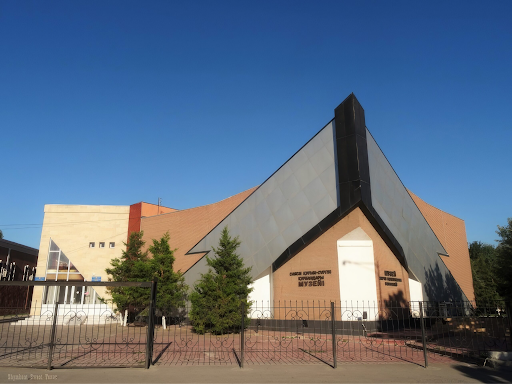
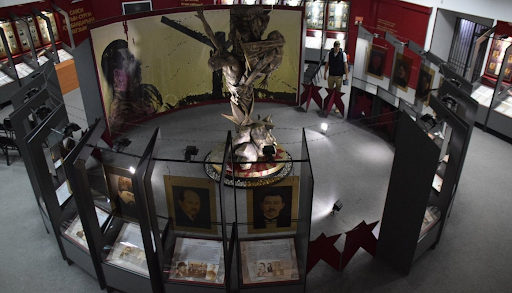
There’s a small museum in Shymkent, Kazakhstan – a few minutes walk from Abay Park – that most tourists walk right past. Inside, a sculpture of human figures in agony stands at the center of the main hall. The Museum of Victims of Political Repression opened in 2001, on the 10th anniversary of Kazakhstan’s independence. It’s one room filled mostly with names on panels, old photos, and there’s a booklet you can pick up at the front desk if you want more detail about what’s on the walls.
I didn’t expect a single room to hold this much. Political repression in Kazakhstan looks small when a country finally gets to tell its own story after 70 years of state mandated silence. Underfunded, the museum is easy to miss if you’re not looking for it. It’s also hard to shake once you’ve stood inside it.
A Conquest, and a Country that Refused to Disappear
You have to go back to the 19th century to understand what happened to Kazakhstan. The Russian Empire spent decades absorbing the Kazakh steppe: first military garrisons, then administrative reorganization, then resettling Russian and Ukrainian peasant farmers onto land that had sustained nomadic Kazakh herding for generations. Tsarist policy pushed the Kazakh people toward assimilation and later, Russification. A nomadic, Turkic, Muslim population was forced to become something more palatable to St. Petersburg.
But the Kazakhs pushed back. Uprisings occurred throughout most of the 19th century. By the early 20th century, a Kazakh nationalist intelligentsia called the Alash movement formed around the idea of self determination, led by people like Akhmet Baitursynov, Mirzhakyp Dulatov, and Alikhan Bokeikhan.
In 1917, amid the collapse of the Russian Empire, they briefly declared an autonomous Kazakh government. It didn’t survive. The Bolsheviks folded Kazakhstan into the new Soviet state, and within two decades, nearly every prominent Alash figure, the same names now on the walls in Shymkent, had been arrested, exiled, or executed.
The Kazakh Famine
What followed is now known as the Asharshylyk, “the great hunger,” one of the least-discussed episodes of mass murder in human history. Historians still can’t agree on an exact number of victims who died from this state-organized famine.
Starting in 1930, Soviet authorities forced collectivization onto a population that had lived as pastoral nomads for centuries. Livestock got seized. Herding families were pushed onto collective farms in a landscape that could not sustain that kind of agriculture. Previously, the Kazakh economy ran almost entirely on animals, and one estimate suggests that the average Kazakh household had 41 animals in 1929, right before collectivization began.
By 1933, that number had dropped to 2.2. Roughly 90% of the republic’s herds were gone. Without livestock, starvation moved fast, and it didn’t let up for three years.
Historians estimate somewhere between 1.3 and 2.3 million Kazakhs were killed in the Asharshylyk, with 4 million victims cited by local sources. Between 38% to 66% of all ethnic Kazakhs died. That’s a higher share than any other ethnic group killed in the Soviet famines of that era, higher even than Ukraine’s Holodomor, a state led, Soviet-era famine that gets far more attention internationally today.
Kazakhs made up 57% of the republic’s population in 1926. By 1939 that number had fallen to 38%, making them a minority in their own homeland. A commission convened once Kazakhstan became independent investigated the famine in 1991 and concluded, in its own words, that the scale of it was monstrous enough to call it a manifestation of “genocidal policy.”
But still, that description is insufficient to describe what the Kazakh people truly lived through during this period. My friend and Kazakh data analyst, Malika Metall, told me that during the worst of it, some Kazakhs were driven to eat their own children just to survive. Survival of the fittest, she called it. Others ate the carcasses of dead animals, whatever hadn’t already been seized by the state or became too rotten to safely consume. None of this made it into Soviet records at the time, but historian Sarah Cameron’s 2018 book, The Hungry Steppe, the closest thing to a definitive academic account of the famine, documents extreme starvation behavior that lines up with what Malika described.
Of course, these were only family stories passed down for generations without an official academic endorsement behind them. But when Soviet state archives finally opened, they corroborated what the stories had been saying all along. The Soviet state never investigated the famine while it was happening. And it never atoned for it afterwards. Public discussion of the famine remained suppressed until the 1990s.
Built for Coal, Not for People
Most of the Shymkent Museum covers the Great Purge of 1937 and 1938 – the arrests, the executions, the disappearances of that Alash generation. The museum’s guide pointed me toward something else running alongside it: a network of forced labor camps built across Kazakhstan during the same period.
The biggest of these was Karlag, the Karaganda Corrective Labor Camp, founded in 1931 and eventually stretching across more than 4.2 million acres of central Kazakhstan. Over the nearly 30 years it operated, hundreds of thousands of prisoners passed through its doors. But what the guide explained, and what historians increasingly emphasize, is that these camps weren’t dropped onto the map at random.
Karaganda sat on one of the richest coal basins in the Soviet Union. Karlag existed largely to supply free labor for the coal and metallurgical industry Moscow built. Prisoners laid railways, worked mines, and fed themselves from state farms carved out of the same steppe their families once grazed animals on. An estimated 5 million people passed through these labor camps and forced settlements in Kazakhstan across the Soviet period though that number includes people from many national groups exiled from elsewhere in the USSR, not only Kazakhs. As such, Kazakh historians sometimes call their own country “the prison of the Soviet Union.”
From Enemy to Asset
Kazakhstan’s relationship with Moscow shifted again during World War II. Afraid a German advance would wipe out Soviet industrial capacity in the west, the USSR moved huge portions of its factories east into Central Asia, Kazakhstan included. Almost overnight, a population the state had spent a decade trying to break was reinvented as essential to the Soviet war effort. Real economic benefits came with those industrial jobs too, even if the underlying relationship remained exploitative. Wartime propaganda leaned hard on the idea of Soviet unity against a shared enemy, and for many Central Asians who fought and worked alongside Russians against Nazi Germany, that unity was genuine rather than just fed to them as state propaganda from Moscow.
Some people in the region still remember the Soviet period that way, as a time of unity, pointing to the war, and further back, to a 19th century steppe culture caught between Russian and British imperial ambitions. Others haven’t forgotten the famine, or what came after it. Kazakhstan housed the USSR’s main nuclear testing site at Semipalatinsk, near Semey, where more than 456 nuclear tests went off between 1949 and 1989. The destructive fallout from the radiation spread during these tests still impacts the region’s population today.
And when the USSR invaded Afghanistan in 1979, the initial force they sent across the border was made up largely of Uzbek, Tajik, and Turkmen soldiers chosen for their language and cultural ties to the Afghans. Moscow later formed the so-called “Muslim Battalions,” recruiting from across Uzbek, Tajik, Turkmen, Kazakh, and Kyrgyz populations in Central Asia on the theory they could pass more easily among Afghans than a Slavic conscript could.
More than 20,000 Kazakhs were sent to fight in Afghanistan, and over 900 didn’t come home. In Shymkent there’s a small memorial to the pilots among them who died standing just off to the side of the city’s main war memorial, a short walk from the museum documenting everything the Soviet state had perpetrated against Kazakhstan by then. A nation that survived a famine, a purge, and forced labor in a massive gulag also sent its own men to fight alongside its former jailers, people it might, in any other circumstance, have called brothers.
I left that one-room museum thinking less about the sculpture at its center than about the small memorial standing nearby, and about Malika’s voice telling me what her family survived. No textbook told me that. Neither did the plaques on the wall. That kind of thing lives somewhere else, passed hand to hand, across the generations that the Soviet state never planned to give voice to.
Conquest, starvation, forced labor, and finally, war asked Kazakhs to die for the same country that tried to break them earlier. Kazakhstan’s 20th century was an attempt to remake an entire people. The language is still here. The steppe is still here. The people are still here. None of that happened by accident. And yet their suffering has been all but forgotten by the rest of the world.
Nawal Ali is the founder of The Steppe Project, a research project focused on nomadic culture and Islam in Central Asia.
Want more like this? Subscribe to the Islamic Horizons magazine and support authentic journalism by Muslims for Muslims.