The Restriction of Knowledge in the Digital Age
By Luke Peterson
Sept/Oct 26
In the two centuries since the appearance of the partisan “penny press” newspapers throughout the United States, the process of providing information to Americans has changed dramatically. Since the 19th century, newspapers have steadily declined across the U.S. as viable business ventures in their own right instead of being subsumed within broader news corporations and collective media conglomerates. Routinely termed “media empires” by analysts in recognition of both their out-sized influence and their transnational nature, these massive media systems today account for a huge portion of the news provided across the U.S.
Media empires now saturate audiences with 24/7 information in the form of news websites, cable and local news stations, radio stations, and print publications. Media empires also engage in the production of non-news media forms such as television, music, and movie production. But these empires are not numerous, nor do they proliferate within the current media market. Rather, they often consolidate their number with smaller corporations subsumed by larger and larger media conglomerates. As such, today there are “fewer than ten mostly U.S.-based media conglomerates towering over the global market.”
For the American media consumer following authoritative news coverage of a given event or series of events, this corporate confluence across ostensibly competitive media conglomerates leads to a substantially narrowed ideological approach to the news leading to consistent repetition of the same perspectives or representations from multiple news outlets. This narrowing is most often visible in coverage of U.S. foreign policy and/or the coverage of events that are geographically distant from the experiential verification of the audience.
The few extant media empires therefore have huge influence over the formation of public opinion in the U.S. even with the proliferation of alternative or independent online news sources. As such, while the news media in the days of the penny press was thought to be a regulator of both unjust government policies and unfair business practices, the contemporary corporate model of news and entertainment media blurs the lines that separate government policy, business interests, and fact-based public information. According to these new parameters, professional journalism within the contemporary U.S. is much less regulatory than it is commercial, and less altruistic than it is profit motivated. In the media environment in the digital age, the interests of public consumers become subservient to the interests of corporate boards, company shareholders, and especially media moguls and their families.
The Big Seven
In the years since media empires began to consolidate and grow, news media production has shifted substantially online with more than 56% of news readers in the U.S. disclosing that they “often” get their news from online sources. Those websites that are most commonly visited by news seekers in the U.S. are tracked by the Press Gazette, a London-based magazine elucidating trends within the global journalism industry.
According to its investigations charting internet traffic in the U.S. between Dec. 2024 and Nov. 2025, there were roughly 45.6 billion visits to major news sites generated from IP addresses within the country’s boundaries. Of those visits, more than half sought out sites controlled by just seven media empires, each controlled by a single mogul or ruling family and each containing dozens of media agencies and affiliated corporate holdings.
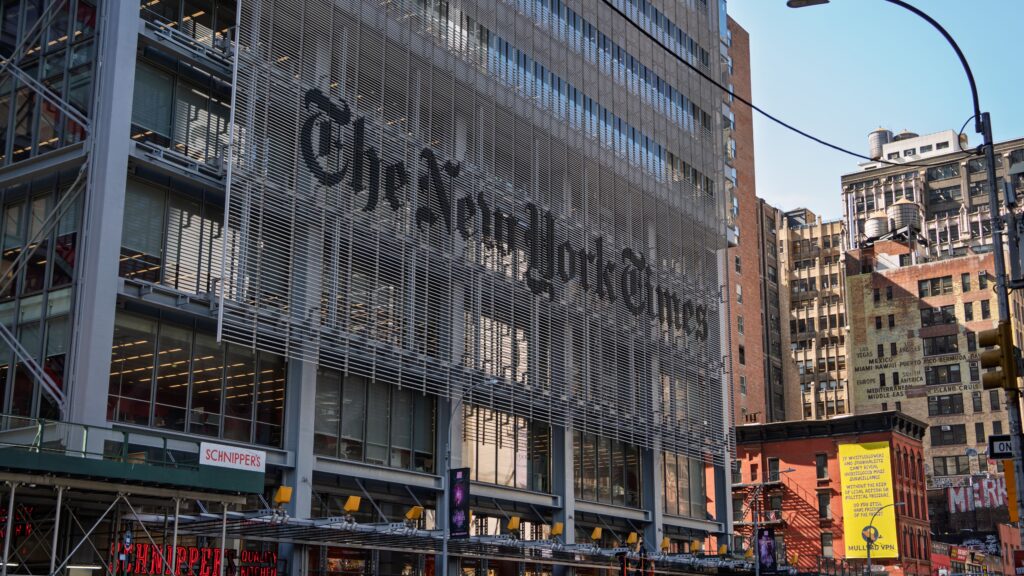
1. The New York Times (the Ochs-Sulzberger Family). This family has been in control of the country’s most highly-regarded paper of record since 1896 during the Gilded Age inequality towards which the country appears to be racing once again. The Ochs-Sulzberger family are unfailingly supportive of Israel and are openly hostile to progressive policies within America, facts that are borne out by the opinions and editorial expressions represented on their news website daily. Four generations of the same family have owned this media empire which today boasts more than 5.5 billion visitors to its news website every year. (https://fair.org/home/the-digital-media-oligarchy-who-owns-online-news/)
2. News Corp/Fox (the Murdoch Family). Just slightly behind the Ochs-Sulzberger empire, Fox News receives around 5.46 billion visitors to its websites annually which include (but are not limited to) Fox News, The Wall Street Journal, the New York Post, British media such The Times, and the tabloid, the Sun. News Corp is owned by right-wing billionaire oligarch Rupert Murdoch who built an expansive global media empire expressing far-right political views while denigrating progressive causes. Today, Murdoch’s billionaire son Lachlan is the head of both News Corp and the Fox Corporation, the two primary wings of this widespread, ultra-right news media empire.
3. Paramount, Warner Brothers, Discovery, CNN, HBO, and TikTok. This media giant is headed by another of Trump’s close associates, David Ellison who, despite the centrist and occasionally critical nature of CNN, is a vocal Trump supporter who recently hosted a private dinner in Washington, D.C. to honor the increasingly unpopular autocrat. For his part, Trump has taken a personal interest in the sale of this massive media empire to the streaming giant Netflix for $83 billion which indicates his intentions to change CNN’s editorial perspective by installing favorable pundits at the news agency. This news and entertainment conglomerate has 4 billion visitors in the course of a year.
4. Yahoo! News and Apollo Global Management. Owned by Republican mega-donor Marc Rowan, Yahoo! News and its affiliated sites receive 2.7 billion views annually operating as an aggregate news site. Still, Rowan’s influence on the rightward drift of the American news media environment is clear. In addition to his millions in donations to GOP candidates, Rowan also sponsored Trump’s 2025 “Compact for Academic Excellence in Higher Education,” a proposal to severely limit international student admissions to U.S. universities while also censuring professorial free speech including any speech critical of U.S. policy or the U.S. relationship with Israel.
5. Comcast. Comcast is a media and technology company overseeing sites that are visited 2.4 billion times a year. Their owner, billionaire media mogul Brian Roberts, presides over a media empire including NBC News, CNBC, and MSNBC, all of which are among the 50 most popular news sites in the U.S. Long viewed as mouthpieces for criticism against the status quo, Comcast holdings actually present a pro-state, pro-corporate viewpoint across their websites and news programming. Station hosts who were formerly critical of the Trump administration were recently removed, leaving this media empire now largely devoid of progressive or minority commentators. Comcast was recently among 37 private donors who contributed to the construction of Trump’s new White House ballroom.
6. Microsoft/MSN. Possibly the exception that proves the rule, Microsoft is not actually family-run but rather owned by a small number of shareholders who dominate the media and tech company’s policy decisions. MSN sites heavily promote automated content given the company’s deep ties to AI development with their CEO Satya Nadella also known to be cordial with the Trump White House. Microsoft also contributed to the construction of the Trump ballroom and before that, donated $1 million to his inauguration fund. Microsoft/MSN sites are visited by an average of 2.1 billion viewers a year.
7. IAC Inc. Rebranded as People Incorporated, IAC Inc. is an umbrella corporation for a variety of news and entertainment outlets like People Magazine and The Daily Beast. Their most senior corporate executive is billionaire Barry Diller who, in a deviation from the norm, has publicly criticized Trump administration policies. Their websites generate 1.9 billion views per year making them less than half the size — and half of the influence on public discourse — of the largest media empires listed here.
News and Knowledge in the Digital Age
As is evident given the descriptions of media empires above, news in the contemporary U.S. is not produced according to democratic means. Rather, the consolidation of media monopolies has actually expanded rapidly since the advent of the Internet, a feature of the media environment that has substantially narrowed the acceptable ideologies proffered in the mainstream news. In practical terms, these relatively new media structures and the continual drive for profit and acceptability by the state have narrowed the range of perspectives provided in the coverage of current events.
For news media consumers therefore, the proliferation of available, modern news media sites does not bring with it a proliferation of points of view when it comes to covering those events. Instead, to a great extent mega-media corporations provide news from those points of view that are most popular, most acceptable, and therefore, most profitable for the individual news outlets and their parent corporations. These restrictions upon available news media perspectives are particularly prevalent in U.S. coverage of events in the Middle East. As such, a subsequent article following up on this topic will examine the relevance of the aforementioned media structures upon U.S. news coverage of recent events in the Middle East.
** Excerpts from this article were adapted from the author’s book entitled Palestine-Israel in the Print News Media: Contending Discourse.
** This article is the first in a two-part series on media empires and the authoritative news coverage of the Middle East for Islamic Horizons.
—
Dr. Luke Peterson is a professor who lectures on Middle East history and politics, U.S. foreign policy, and the Arabic language. His latest book, The U.S. Military in the Print News Media: Service and Sacrifice in Contemporary Discourse, is available in paperback from most online book sellers.
Want more like this? Subscribe to the Islamic Horizons magazine and support authentic journalism by Muslims for Muslims.