How Islamic Influence Can Transform a City
By Cynthia Griffith
May/Jun 25
The teeming metropolis of Philadelphia is a mecca of art and architecture, and due to its massive Muslim population, it is also known as the “Mecca of the West”. Here, you will encounter hundreds of thousands of Muslims shuffling across the cobblestone streets as they stroll past prestigiously preserved ruins of colonialism – sites like the Liberty Bell, Independence Hall, and the Betsy Ross House – to find the nearest house of Islamic worship. Muslims in Philadelphia can find camaraderie and purpose through prayer gatherings at local masjids.
And every Muslim here has a story. Tales take root as far as Central Asia and as close as the 69th Street Terminal. These stories are told through the writing on the walls of the more than 60 known mosques in the city.
Before the indisputable growth of Islam in the region, these structures served as theaters, churches, warehouses, and nightclubs. Today, they are beacons of the Muslim faith. And through these beacons, Islam has transformed the spirit of Philadelphia, a truth made evident in the city’s buildings as much as it is etched in the hearts of the people who worship inside them.
“The history of Islamic-influenced architecture in the United States hasn’t been given its due for many years. It dates back at least to the late 19th century – longer if Moorish architecture (a blend of Islamic and Spanish) is considered,” wrote Jonathan Curiel in an expose about the influence of Islamic design on American cities.
Arches, domes, minarets, and geometrical patterns that adorn buildings all over the U.S. are reminiscent of distinctive Islamic designs. In Philadelphia, there is overt influence through transformative construction where the embrace of Islamic architecture makes its way into the city’s infrastructure.
A Converted Furniture Warehouse Becomes the “Doorway to Peace”
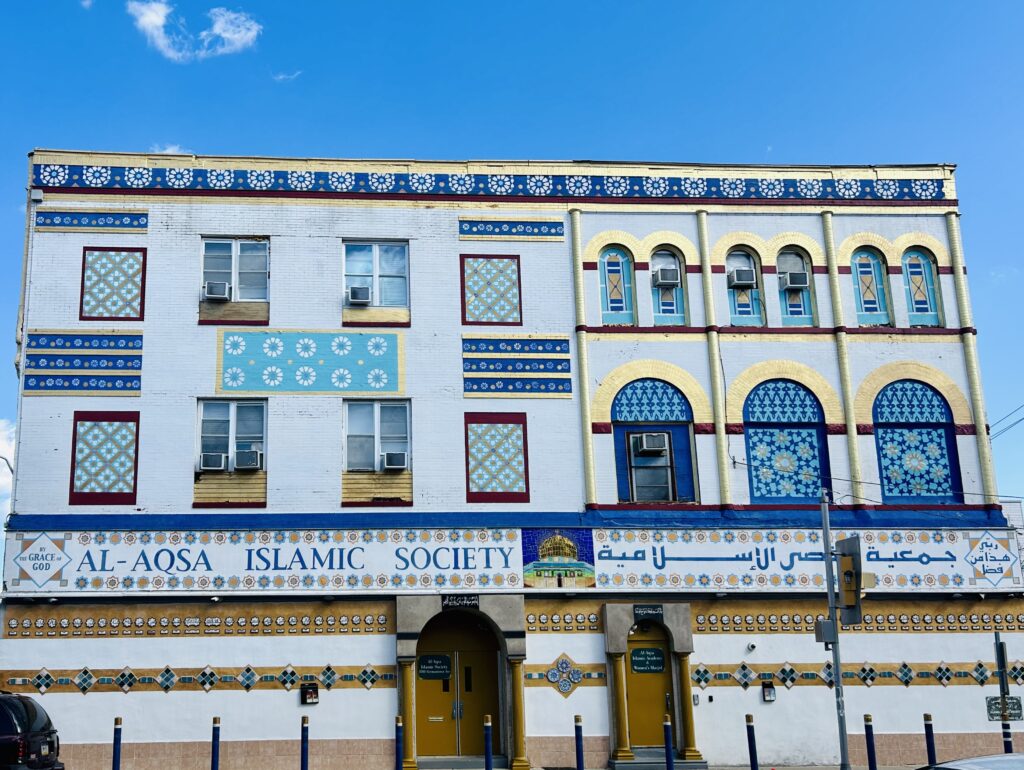
When one walks down the bustling streets of Kensington, a Philadelphia neighborhood, it is difficult to miss the mosaic-laden masjid piercing the royal blue sky with an array of vibrant colors. Each meticulously painted tile is strategically placed along the building’s exterior, creating a visually striking landmark that is every bit as iconic as it is spiritual. Painted in the corners are the 99 Names of Allah, along with geometric shapes juxtaposed with skillfully rendered Arabic calligraphy.
It is difficult to uncover the tale of interconnectedness that is the human experience as we cross continents and cultures like the strokes of a pointed paint brush. But if you want to know the truth about the people in the City of Brotherly Love, you will find it not in the spoken word but rather written on the walls of the city’s buildings, particularly the buildings where Muslims go to nourish their souls. At Masjid Al-Aqsa Islamic Society, the former Dubin Company furniture warehouse on Germantown Avenue takes on a new role as a mosque, muse, and urban refuge.
The story began in 1989 when Palestinians fleeing Israeli violence and oppression in the West Bank village of Mukhmas found their haven in Philadelphia. Settling in around North 2nd Street, a thriving Palestinian community grew. Over the years, that community expanded traversing race, culture, ethnicity, and religion. A close-knit circle of like-minded thinkers, business owners, and spiritual leaders was born embodying traditions from across the Arab world, including Iraq, Syria, and Lebanon. In the same year, a defunct furniture warehouse was transformed into a cultural phenomenon, but the labor of love that we see today was decades in the making.
In 2003, the Al-Aqsa community (as the North 2nd Street neighborhood came to be known) enlisted the Mural Arts Program, the Arts and Spirituality Center, and Hancock St. John’s United Methodist Church, along with artists Joe Brenman, Cathleen Hughes, and Fadwa Kashkash to take on a rather ambitious project. This collection of artisans and activists were tasked with painting the new mosque in a way that reflected the diversity of the people inside it. The project, entitled “Doorways to Peace” was part of a broader initiative to foster interfaith dialogue and encourage community cooperation. It was an overwhelming success. Today, the former furniture building is not only a masjid but also a school, a grocery store, and a communal space complete with a playground, outdoor cafeteria, and youth club.
A Former Theater Was Turned into the Largest Mosque in West Philadelphia
In 1984, the University of Pennsylvania’s Muslim Student Association raised $100,000 to build a mosque and Islamic studies center in the heart of West Philadelphia.
The result of that effort was Masjid Al-Jamia, an Arabic phrase which loosely translates to “The Congregational Mosque.” Situated at 4228 Walnut Street, this eclectic mosque may appear rather unremarkable at first glance. However, its interior is vast and meticulously decorated from the ceiling to the floor. It is a modern marvel in a most unsuspecting locale. If you stand on the mosque’s burgundy and gold carpet and close your eyes, the architecture might harken back to a completely different time when the theater was center stage.
In 1928, the site of The Congregational Mosque of West Philadelphia was owned by the Stanley-Warner Theaters chain and operating under the title “The Commodore Theatre.” The building’s Spanish Revival and Moorish architecture takes cues from the swank stages of a pre-cinema America unfolding during the Golden Age of Hollywood (Ken Roe, “Commodore Theatre, 4228 Walnut Street, Philadelphia, PA”, Cinema Treasures). Once a space for the likes of Marlon Brando and Lon Chaney, it is now a beacon of religiosity guiding people away from on-screen idols and the nickelodeons of yore, and back to the straight path of God.
World-renowned Imam Converted a Violent Night Club into a Place of Prayer and Peace
Imam Okasha Kameny is one of the most well-known reciters of the Quran. When he is not busy beautifying the speech of God and teaching the next generation, he is rebuilding neighborhoods one mosque at a time. But perhaps his most lasting impact is the story of Philadelphia’s Masjid Al-Wasatiyah (MAWI).
This tiny, unassuming mosque situated behind a tall metal fence was once a string of abandoned buildings across the street from a nightclub where, according to the Philadelphia Tribune, “drug dealing, prostitution, casual sexual activities, and a murder” transpired (Samaria Bailey, “Masjid Al-Wasatiyah Wal-Itidaal: Reclaiming and rebuilding in SW Philly,” September 26, 2020, The Philadelphia Tribune). In those days, the streets in this section of Southwest Philly were strewn with waist-high trash. Today they gleam with cleanliness and are surrounded by peace and calm. And Masjid Al-Wasatiyah is at the center of that radical transformation.
In 2020, neighbors in this community raved about this positive transformation. Imam Kameny, along with several other Muslim leaders, kept the promise to “feed the soul of the people.” Today, the overall atmosphere on the streets near to this mosque is hopeful and serene as MAWI continues to foster faith, justice, and positive Islamic values.
Expansion Plans Continue After Leaders Purchased a Church in Germantown
Situated along bustling Germantown Avenue, Masjid as-Sunnah an-Nabawiyyah, more widely known as Germantown Masjid, is heralded for its dawah center which guides countless new converts to Islam. Located in a predominantly African American section of the city, this house of worship is emblematic of the resilience of Philadelphia’s Black Muslim population.
Within the walls of this thriving community center, you will find programs ranging from marital counseling to Islamic estate planning. What you won’t find is the mosque’s latest effort at expansion via the purchase of a centuries-old church. That church, originally erected in 1858, became the property of local Islamic leaders last Ramadan.
The Houses of Allah in Philadelphia are more than just gathering spaces where religious edicts are followed, exchanged, or observed. The mosques of this city are also small pieces of history contributing to an inspiring picture of what faith looks like in modern Philadelphia.
Cynthia C. Griffith Is a social justice journalist focusing on environmental and civil rights issues. She’s a regular contributor at Invisible People where her musings about the earth, space, faith, science, politics, and literature have appeared on several popular websites.
Want more like this? Subscribe to the Islamic Horizons magazine and support authentic journalism by Muslims for Muslims.