A Reflection on Unity to Honor the Leader’s 100th Birthday
By Nahid Widaatalla
Jul/Aug 25
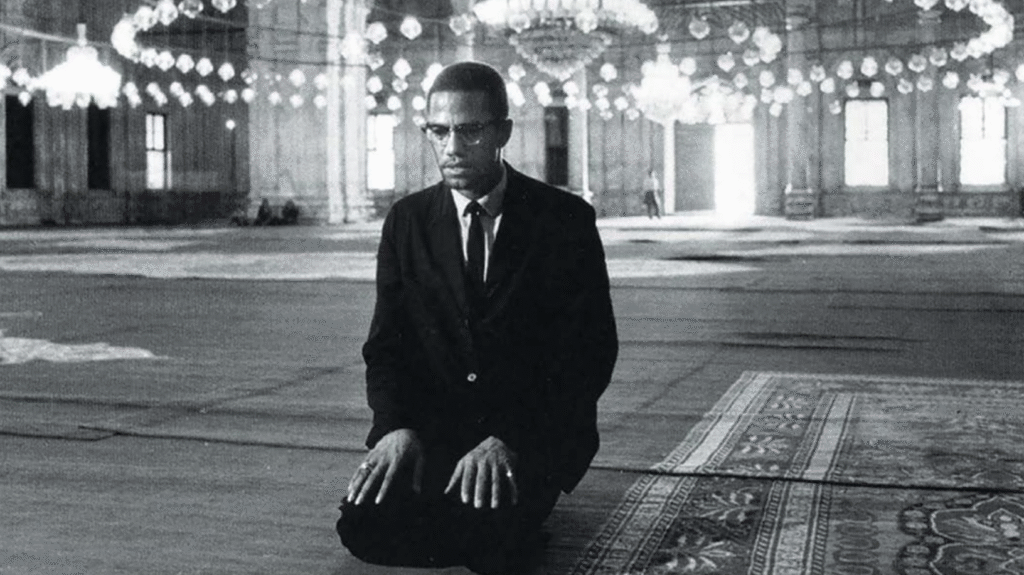
El-Hajj Malik El-Shabazz’s (Malcolm X) Letter from Mecca, written in April 1964, documents his first Umrah (pilgrimage similar to Hajj). Malcolm X, a prominent African American leader during the Civil Rights Movement, wrote of the interracial dynamics he witnessed between Muslims in the holy city. 61 years later, my own trip to Mecca during Ramadan inspired me to assess his observations and their applicability to the state of the global Ummah today.
Malcolm X and Racial Unity
Malcolm X began his letter by emphasizing the spirit of brotherhood he felt during his trip. Worshipping with Muslims of all colors, particularly white Muslims, convinced him that “America needs to understand Islam, because this is the one religion that erases from its society the race problem.”
His experience in Mecca was in stark contrast to 20th century racial segregation in the United States. As a result, he painted Islamic unity as an antidote to anti-Black racism, but his observations don’t mean that Muslim communities are free of anti-Blackness. Unity was not an inherent trait, but rather a conscious choice made by Muslims then and now.
Like Malcom X, I observed the beautiful kindness and generosity of Muslims during my pilgrimage to Mecca. Countless women insisted I break my fast with them, sharing food and drinks without hesitation. Many created space for me to join them on their prayer mats. The sense of peace in the air makes you feel like you are exactly where you need to be.
In an earlier letter written in 1946 before his conversion, Malcolm X vented to his brother from jail about the phoniness of religious preaching he heard from Muslim inmates, calling it “just talk.” In a subsequent letter written in September 1964, Malcolm X described his newfound membership in the World Muslim League as working towards “a greater degree of cooperation and working unity in the Muslim world.” This change of heart aptly illustrates the powerful difference between hearing about something, in this case the teachings of Islam, and experiencing it for yourself.
The Specter of Racism in the Muslim World
While Mecca is a place that brings out the best in people, it also has the potential to bring out the worst. 92 million people visited the holy mosque during Ramadan this year, striving to worship as close to the Kaaba as possible. People shoving the elderly and scolding the young were common sights. These negatives, however, can sometimes be exacerbated by race.
The kafala system used in many Middle Eastern countries brings migrant workers from impoverished countries to wealthy Gulf states for cheap labor in exchange for visa sponsorship. These transitory laborers commonly face low wages, poor working conditions, and racial abuse in and outside of the workplace.
South Asian and African migrant workers in Saudi Arabia specifically face substantial racism. At a fast-food restaurant in Mecca, I witnessed an Arab man cut in front of a line of people waiting to pick up their orders. He callously waved his receipt at a South Asian worker, making no eye contact. The worker, visibly intimidated, rushed to put the man’s food items into a bag and handed it to him without question.
But this exchange between the Arab patron and South Asian worker was not an isolated incident. In fact, some argue that anti-Blackness among Muslims is becoming rampant and affects all Muslims who have darker skin. It’s why people choose a mosque based on the racial background of the attendees, and why interracial marriages are considered taboo by some Muslims. It’s why atrocities like the ongoing war in Sudan, shadow-funded by the United Arab Emirates, do not get much attention in the Muslim world.
The “white attitude” that Malcolm X describes is not only reserved for white people; it is a fundamental belief that a person is inherently superior to another based on the merit of their race, and because of this, their needs are more worthy of being met.
In his farewell sermon, Prophet Muhammad (salla Allahu ‘alayhi wa sallam) warned, “An Arab has no superiority over a non-Arab, nor a non-Arab has any superiority over an Arab; also a White has no superiority over a Black nor a Black has any superiority over a White except by piety and good action.”
Wealth and Community in Mecca
In addition to race, social status can shield against negative experiences in Mecca. There is an inherent privilege in having the time, money, and physical health to travel to the holy city. When you are not hustling among sweaty crowds, relaxing and enjoying a hotel meal is a luxury. Malcolm X described his experience as a state guest, highlighting the Saudi government’s provision of “a car, a driver, and a guide,” and “air-conditioned quarters and servants in each city that I visit.” This treatment is by no means normal. Travelers who aren’t protected by status often cook for themselves, pray on the streets, and walk long distances, often in the sun, to get to their accommodations.
The people living furthest away from the holy mosque are largely African and South Asian, while those living closer by are mostly Arab or Westerners. But inside the mosque, these differences become almost invisible. There is no way to know who is poor, rich, or famous, with everyone wearing the same white ihram and weeping the same tears as they worship. In Surah Al-Hujurat Ayat 13 (49:13 Quran), Allah says, “Indeed, We created you from a male and a female, and made you into peoples and tribes so that you may (get to) know one another.” Umrah gathers people from all corners of the earth, displaying the vastness of Islam and the diversity of Muslims.
Islam’s answer to the “race problem,” as Malcolm X called it, is an emphasis on community. This was most apparent to me during taraweeh and tahajjud prayers, with thousands of Muslims praying fervently for the people of Palestine. During my time in Medina, the second holiest city in Islam, I met a young local woman named Afnan. We sat together on the outskirts of the mosque courtyard, listening to the imam’s Quran recitation. Afnan told me she regularly visits the mosque when she can’t pray, just to listen, observe, and experience the feeling of being around so many Muslims.
In Islam, congregational prayer is an intimate communal experience. Physical touch is exercised between strangers standing shoulder-to-shoulder, while the solid, structured rows of people create a visual of unity. In a Sahih hadith narrated by Abdullah ibn Umar, the Prophet Muhammad said, “Whoever joins up a row, Allah will join him up (with His mercy), and whoever breaks a row, Allah will cut him off (from His mercy)” (Sunan Abī Dāwūd Book 8, Hadith 101).
When gaps in prayer rows occur, they stick out. People shy away from filling these gaps because it can be tough – moving everything to a different line, standing next to someone with a crying child, or praying beside someone who doesn’t smell great. But being part of a community means accepting inconvenience. This includes forgiving the faults of others and sacrificing personal comfort for the sake of something bigger. There may come a time when we are the ones with a crying child or become the elderly person who whispers their prayers a little too loudly.
Sacrificing comfort can also mean using your abilities to uplift another person while disadvantaging yourself. I witnessed countless strong, tall people refrain from pushing ahead in a crowd during Umrah to stay back and shield a weaker person from being shoved.
Malcolm X, Islam, and Spiritual Truth
In his April 1964 letter, Malcolm X discussed the “spiritual path of truth” as a means of healing the disease of racism in America. Much of what he predicts about younger generations leading this search for truth can be seen today in the resistance of university students against institutions that enable the genocide of Palestinians. There is a present-day search for spiritual endurance in a burning world. This endurance, offered by faith, keeps hope alive while comforting the part of us that yearns for an answer to everything.
Malcolm X’s letter from Mecca is therefore a basis for reflection on the condition of Muslims today. While the issue of racism persists within Muslim communities, Islam’s unwavering messages of unity, generosity, and brotherhood stand the test of time.
Nahid Widaatalla is a public health professional and freelance writer/journalist, covering social justice, Islam, digital health, and more.
Want more like this? Subscribe to the Islamic Horizons magazine and support authentic journalism by Muslims for Muslims.