Islamic History in a Family Film
By Yusra Shakaib
May/Jun 26
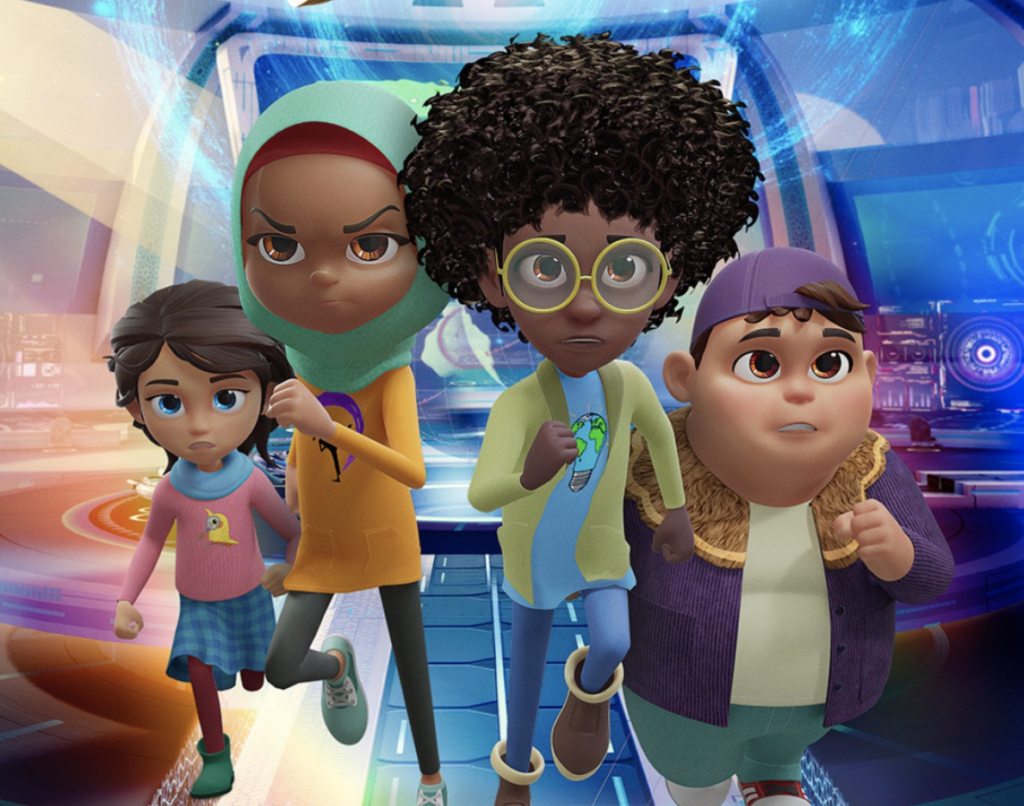
Milo Productions film “Time Hoppers: The Silk Road” directed by Canadian Muslim filmmaker Flordeliza Dayrit takes an educational approach to exploring the history of technological growth during the Islamic Golden Age. The 80-minute runtime is ideal for viewers of all ages
The film, released in international theaters on Feb. 7, is set in the year 2050 and follows four children – Abdullah, Aysha, Khalid, and Layla – who are students at the Aqli Academy in Vancouver, British Columbia. The group stumbles upon a time machine that the academy had been developing and then accidentally go back in time to the ninth century Baghdad. There, they witness an alchemist named Fasid trying to steal the work of famous mathematician Al-Khwarizmi.
Academy teachers Hafsa and Habib guide the children through their journey in time. However, when Fasid steals a crucial piece of the time machine, the characters must work together, facing challenging obstacles along the Silk Road to retrieve it from him. Through their journey, the audience learns about some of the technological advancements developed by Muslim scholars such as the astrolabe and advanced mirrors.
The film stars Emily Gin as Abdullah, Angel Haven Rey as Aysha, Tareek Talati as Khalid, Jayce McKenzie as Layla, Morris Seng as Facid, Aliyah Harris as Hafsa, and Omar Regan as Habib. Other Muslim celebrity appearances in the film include the voices of Dalia Mogahed, Omar Suleiman, and Yasir Qadhi.
The film stresses the ideas of empathy and selflessness and audiences witness this through the portrayal of relationships between the kids and the adults. They see this when Abdullah gets left behind in the year 900 because he dropped his time travel device and his friend Layla feels responsible for it. She then struggles later when debating if she should tell him about what happened. There were also scenes where Layla and her father Habib have honest conversations about the passing of Layla’s mother.
I saw the film in theaters with my younger cousins and was very excited to see a Muslim children’s film on a big screen for the first time. Many theaters in the Chicago area were sold out or almost filled to capacity. My favorite part of the film was seeing the excitement the characters from the past had about the astrolabe and its significance. The astrolabe was created by the ancient Greeks in 150-200 BC but later perfected by Muslims in the 8th or 9th century. In my experience, most inventions or historical advancements engineered by Muslims are usually glossed over or omitted from many American history lessons, so it was nice to see these accomplishments emphasized on the big screen.
This segment also featured a little girl named Maryam from the past who had been building an astrolabe for an inventors competition without her father, a respectable inventor, knowing. This was very wholesome to watch as it celebrated her creating something by herself and strengthening her relationship with her father.
While overall a quality production, the filmmakers could have made some tweaks that would have made for a better viewing experience. For example, characters would sometimes speak without animation in their faces or bodies. And as the target audience is children, more funny and goofy moments between the characters were needed. While the emotional and serious scenes added depth, some children may have been more engaged if there was some comedy to balance everything out.
Additionally, the movie was also only in theaters for two days during Super Bowl weekend when many families may not have prioritized seeing it. The limited release coupled with the lack of a large marketing campaign may have worked to the film’s disadvantage.
Those interested in watching “Time Hoppers: The Silk Road” can buy or rent the film on YouTube, AppleTV, or Fandango at Home.
Yusra Shakaib is a college student who enjoys writing and traveling.
Want more like this? Subscribe to the Islamic Horizons magazine and support authentic journalism by Muslims for Muslims.