Muslim Gig Workers Face Another Daunting Ramadan
By Umar Ibrahim Agaie
Mar/Apr 26
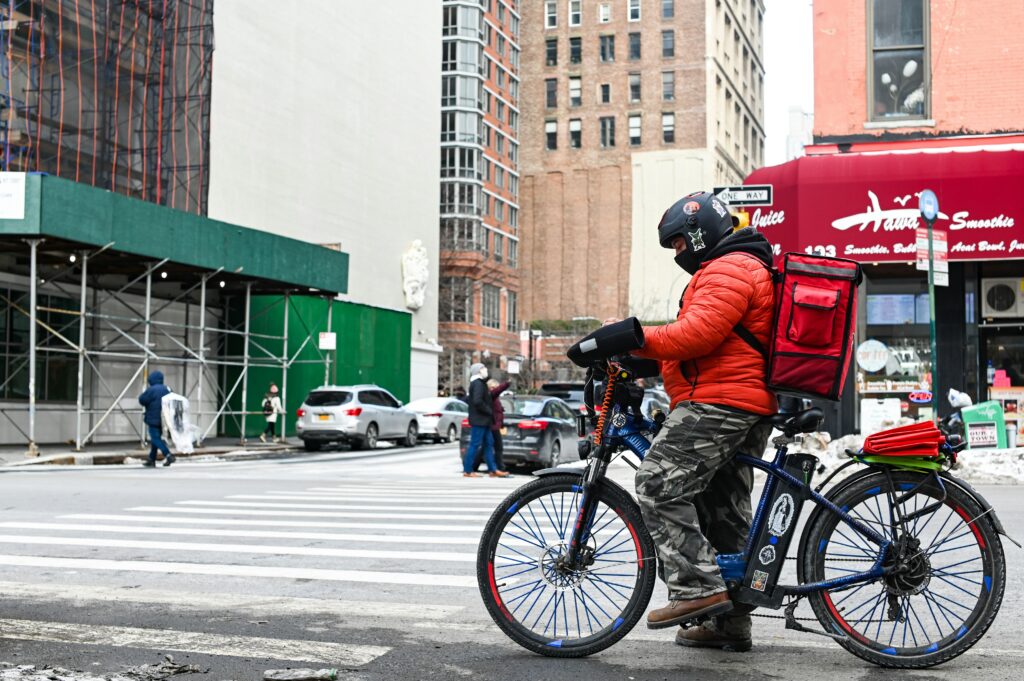
Every Ramadan for the past five years, in the silent pre-dawn hours, 42-year-old Aisha Muhammad wakes up to prepare suhoor in her modest Chicago apartment. She prepares the pre-fast meal knowing the food and water must sustain her for the next 16 hours. By about 4:30 a.m., Muhammad is already walking down the cold, empty streets to begin her 12-hour shift as a home health aide for her client, an elderly woman of Polish descent in her late 70s.
Her patient suffers from advanced dementia, and Muhammad’s duty is to bathe, feed, and care for her, manage complex medications, and prepare meals that Muhammad herself cannot eat. To her, the physical and mental toll of maintaining compassion and precision while observing the Ramadan fast is undoubtedly perseverance and servitude to God in its purest form.
She described the long day as a test of endurance. “You are managing your own body’s needs while being fully present for someone else’s,” she said.
44-year-old Abubaker Omar, another Chicagoan home health aide, faces similar circumstances. “Hunger is one thing,” he said. “The harder test is the exhaustion that sets in by afternoon and the loneliness of breaking your fast alone in a client’s home with just dates and water. Of course I would prefer my iftar happens at home with family or in a masjid with the congregation.”
Omar’s Ramadan lays bare a reality faced by thousands who observe the Ramadan fast in the constraints of the U.S. economy: a profound devotion tested by the unending demands of low-wage but essential work.
Data shows religious freedom among workers is not equally distributed. While the Supreme Court’s 2023 decision in Groff v. DeJoy strengthened the legal right to accommodations, accessing them remains a daily struggle. For Muslim workers, employment discrimination is consistently a top category of civil rights complaints, according to the Council on American-Islamic Relations (CAIR). Additionally, federal enforcement actions over denials of prayer breaks and schedule changes are at a near-decade high, according to the U.S. Equal Employment Opportunity Commission (EEOC).
For workers like Muhammad and Omar, this systemic failure turns the holy month into a fight for both faith and livelihood. For example, Muslim gig workers often face intensive management issues, making it hard to take breaks for religious needs.
For years, the legal framework that is supposed to protect workers was flimsy. The standard came from a 1977 Supreme Court ruling in the Trans World Atlantic v. Hardison case that allowed employers to deny religious accommodations if they imposed more than a “de minimis,” or trivial costs on the employer. This low bar allowed employers to reject requests for prayer breaks or schedule changes during Ramadan by citing major costs or administrative hassle.
The Supreme Court’s unanimous decision in Groff v. Dejoy in June 2023 changed that. The Court rejected the “de minimis” standard, ruling that an “undue hardship” must mean a “substantial increased cost in relation to the conduct of the employer’s particular business.” The burden of proof shifted dramatically. Employers must now carry out a fact-specific analysis of real operational or financial impacts. Resentment amongst coworkers or occasional scheduling adjustments are no longer considered valid reasons for denial. A surge in enforcement actions by the EEOC marked a new era of strategic legal scrutiny. For Muslim workers, a request for a sunset break to observe iftar or a schedule shift for night prayers can no longer be denied based on claims of inconvenience.
“For workers in hospitals, warehouses, and delivery jobs, Groff was a significant shift,” explained Jaylani Hussein, a civil rights attorney for CAIR. “Before, an employer could claim having to cover a 15-minute prayer break was too disruptive. Now, they must prove that the break is substantial to their whole operation. It is a powerful tool, but it only works if the employee feels safe to use it.”
This caveat reveals the gap between legal theory and the reality in workplaces. The fear of subtle retaliation by coworkers or employers often outweighs the promise of legal recourse. “The law is only as strong as the workers’ ability to invoke it without fear,” Hussein said. “For workers in essential roles, that fear is still very real.”
While Groff strengthened protections for traditional employees, gig workers do not enjoy this benefit. Classified as independent contractors, they are exempted from the Title VII’s protections, making religious accommodation legally nonexistent.
Carlos Mendoza, a 34-year-old Colombian American convert and delivery driver in Phoenix, is faced with this issue daily when he drives for multiple apps to support his family. “The app doesn’t know it’s Ramadan,” he said. “If I pause for [a few] minutes to pray to Allah and for iftar, I lose my ‘priority driver’ status, get fewer offers, and my income reduces that week. There is no human to request a break from. The system is designed for maximum uptime.”
Mendoza’s experience is the result of a flaw deliberately engineered by corporate lobbying. While states like California boast strong religious accommodation laws, Proposition 22 reclassifies app drivers as contractors, denying them both religious rights and wage protections. Hannah Lee, a labor policy analyst at the Economic Policy Institute described this as a two-tier system of justice. “A warehouse worker in California has robust rights to request a prayer space,” she said. “A delivery driver dropping off at the same warehouse has none. Religious freedom is becoming contingent on a corporate-friendly employment classification.”
The strain is most acute in round-the-clock essential sectors where rigid schedules clash with religious obligations. In workplaces like hospitals, factories, and sanitation departments, the spiritual conflict is not just with management policy but with the architecture of shift work itself.
Dawud Okeke, 42, is a Nigerian American Muslim and an overnight sanitation truck operator in Houston who was denied religious accommodations. “My suhoor is at 5:00 a.m., just as my shift ends. I’m operating a 20-ton truck on little sleep and an empty stomach,” he said. “I requested a shift change to a daytime route during last year’s Ramadan. My supervisor said it would disrupt seniority and he denied it. After the Groff ruling, I went to my union rep. Next year, during Ramadan, we are preparing a formal grievance.”
Dawud’s situation in Texas, a state with minimal workplace religious protections beyond federal law, shows why collective action matters. His grievance is a test case for applying the Groff-standard to municipal shift work like his.
The most visible change in the status quo is emerging at the intersection of faith and labor advocacy. Unions like the Service Employees International Union (SEIU) Local 73 in Illinois partner with mosques to educate members about their rights and bargain proactively for religious clauses. These partnerships mostly begin with workshops where union organizers explain workers’ rights and the imams provide religious context for why these accommodations are non-negotiable matters of faith.
“Religious accommodation is a fundamental workers’ rights issue,” said Maria Chavez, a lead organizer with SEIU Local 73 in Chicago. The union is working closely with imams to have a good understanding of the needs of Muslim workers like timing for suhoor and iftar breaks. They have negotiated specific accommodations like clear prayer break policies, floating holidays to cover Eid al-Fitr, and fair shift-swapping.
This way, requests for fragile appeals are turned into contractual or binding rights. A 2024 contract with a major Chicago-area school district is a prime example. The school now includes a guaranteed “floating religious holiday” and makes provision for a clear process for shift swaps during holy months. In non-union workplaces, requests are easily denied. In unionized settings, they become enforceable contract terms backed by grievance procedures. This model is now becoming an inspiration to similar labor coalitions in Michigan and New Jersey.
But action is still required on multiple fronts. The recent Groff legal victory is celebrated as a new era for religious accommodation as it requires mandatory action. HR training and updated EEOC guidance must be implemented, putting in place clear parameters such as scheduling accommodations for Ramadan. Furthermore, legislative reforms like the Protecting the Right to Organize Act must also be implemented to close the regulation gaps in the gig economy. Workers with intersecting identities like Muslims, immigrants, people of color, and low-income earners must be relieved of their amplified inequities.
For Muhammad, the need is simple: be acknowledged and valued as a whole person. “This isn’t about special favors,” she said. “It’s about being treated as a whole person. I am a caregiver, a Muslim, a woman providing for her family. When my employer allows a five-minute break or avoids scheduling a double shift during the last 10 nights of Ramadan, it signals, ‘We see you, and your faith matters’.”
This Ramadan, thousands of Muslim essential workers will complete their fasts, a powerful testament to faith under pressure. Their dawn prayers observed in break rooms and solitary iftars eaten in delivery vans are more than private acts of devotion. They are a quiet but persistent claim to a fundamental truth in a nation built on freedom: that economic precarity should not be the price of piety or humanity. Their struggle makes clear the urgent work ahead: building true religious freedom into American labor so that labor is met with dignity, not disregard.
Umar Ibrahim Agaie is a writer dedicated to documenting the human cost of economic policy. By centering the stories of workers, immigrants, and people of faith, he challenges readers to see the gap between America’s legal promises and its lived realities.
Want more like this? Subscribe to the Islamic Horizons magazine and support authentic journalism by Muslims for Muslims.