The Long Road Back to the Booth and the Ballot Box
By Anime Abdullah
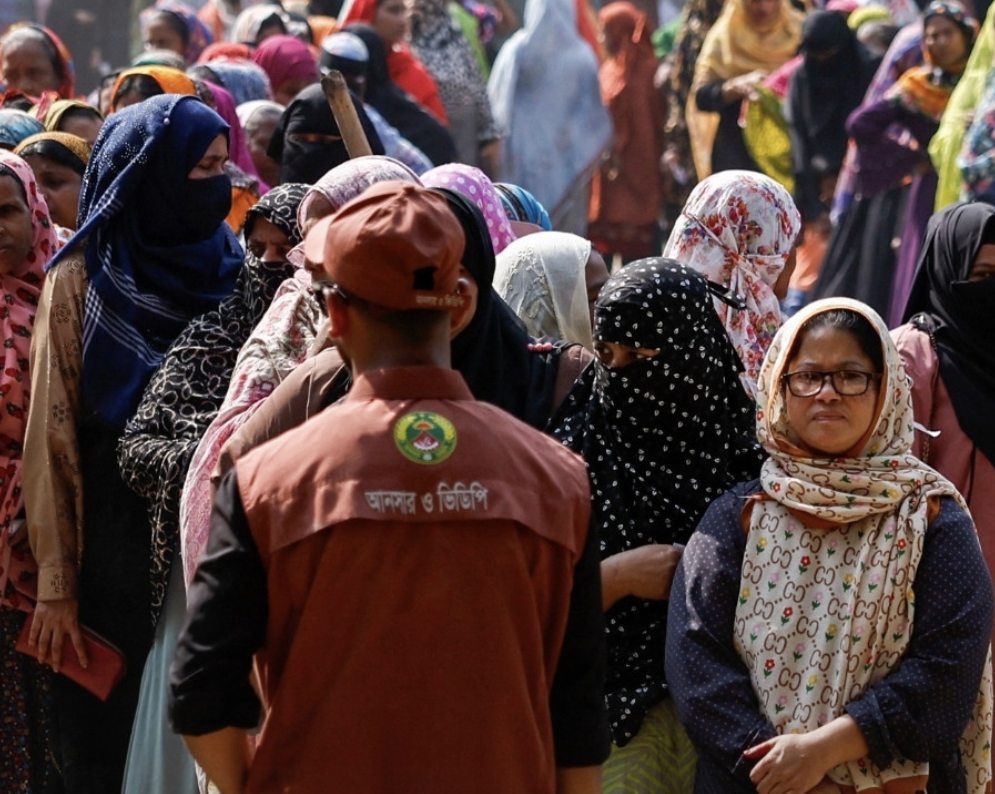
“At the bottom of all tribute paid to democracy is the little man and woman, walking into a little booth, with a little pencil making a little cross on paper.” – Winston Churchill
For 17 years the “little men and women” in Bangladesh, were kept away from voting booths. Successive elections passed without them. Ballots existed, but choices did not. The booths stood as empty monuments to a stolen right. Citizens were instructed to watch, to accept, to applaud while their voices were muted for the sake of authoritarian convenience wrapped in the language of national stability.
But on Feb. 12, the silence broke. The country did the politically inconvenient: it voted. Those “little men and women,” whom Churchill once romanticized, finally returned to those “little” booths, not with pencils but with small seals marking the same ancient, democratic right to choose.
After years of enforced quiet, Bangladeshis cast a seemingly free ballot to elect its 13th National Parliament. Anticipation pulsed through the nation’s 127.7 million voters, per the Global Voices. The weight of the moment fell heaviest on the country’s 56 million youth — comprising 44% of the electorate — voting for the first time to confront a future defined by rare and bracing uncertainty. Yet, the road to this renewed vote was steep, violent, and unforgiving.
The Road to Election: A Horizon Baptized in Sacrifice
Bangladesh’s constitution mandates elections every five years, but the 13th national poll arrived in just 26 months. The rushed return to the ballot box was the direct consequence of an autocratic ruler collapsing under a nationwide uprising in Aug. 2024, only seven months after its unlawful seizure of power for the third time.
This political horizon did not emerge through negotiations. It clawed its way into existence over a mountain of corpses and was baptized in blood. According to the United Nations and the Daily Observer, in July 2024 alone, more than 1,400 people were killed, and thousands more now live with permanent injuries and disfigurements–the price paid to bring down the fascist regime led by the Bangladesh Awami League (BAL). In the aftermath, Nobel laureate Prof. Muhammad Yunus assumed leadership of the interim government, pledging reforms, justice for the July killings, and a credible election.
Reform, however, came slower than many expected. The fall of the BAL created an immediate crisis of centralized authority. While the former government fled with its ministers and loyalists, the bureaucracy remained filled with those it had selectively appointed, including the president and the army chief, whose actions remained questionable.
The newly-formed student movement brought energy but lacked experience in navigating entrenched political cunning. Authority and priorities fractured across the emerging student leadership, the interim government, Yunus, and his advisors, many of whom were quietly influenced by previously appointed bureaucrats and career secretaries.
Despite these competing centers of power, on Nov. 13, 2025, the government announced that the national election and a historic referendum would be held on the same day. The referendum proposed an upper house elected through proportional representation — an unprecedented structural shift. Debate followed, but on Dec. 11, 2025, the Election Commission confirmed Feb. 12 as polling day.
Campaigns erupted. Rhetoric hardened. Airwaves filled with accusation and counter-accusation. Social media became a battleground between followers of the Bangladesh Nationalist Party (BNP) Chairman Tarique Rahman, Bangladesh Jamat-e-Islami (BJI) party’s Ameer Shafiqur Rahman, and the National Citizen Party (NCP) Convener Nahid Islam.
Yet compared with the violence of past elections, the atmosphere remained strikingly restrained. On polling day, 42,779 centers stood ready. With 64.8 million “little” men, 62.9 million “little” women, and 1,234 third-gender voters, this election became one of the largest democratic exercises of the year, according to Global Voices.
A Binary Contest: The Birthday of a New Bangladesh
With the old guard dismantled, the electoral field transformed. Most BAL leaders fled to avoid accountability for years of corruption and repression. In fact, the once dominant BAL was barred from contesting the election under the Anti-Terrorism Act.
In their absence, 50 registered parties fielded 1,755 candidates, joined by 273 independents, giving voters wide choices across 300 seats. However, voters gravitated toward parties with established histories, clear leadership, and national networks. BNP seemed to fit this profile the strongest. The BJI retained a significant base, while the student’s NCP did not.
The students led the uprising that toppled the previous government, but their newly-formed party failed to emerge as a major electoral contender. They lacked national organization, had a smaller voter base than the BNP or BJI, and received limited attention in major media coverage.
To consolidate support, the NCP allied with the BJI. The decision was contested internally and several NCP leaders and founding members publicly opposed the move and resigned, citing the BJI’s debated past and its positions on key social issues, including women’s rights.
Despite ideological differences, the alliance gained momentum largely through their shared opposition to Indian influence. Ultimately, the contest narrowed to a direct fight between the BNP and a BJI-led coalition. Even with this simple lineup, voters faced a stark choice between two sharply different visions for the country.
Calling election day the “birthday of a new Bangladesh,” Yunus urged citizens to remain calm and shape the country’s future through their vote. International observers, including over 200 EU observers, monitored the process closely.
A Landslide that Masks a More Complex Reality
The center-right BNP-led alliance secured a landslide victory, capturing at least 212 of the 300 seats. The BJI-led alliance emerged as the second-largest bloc with approximately 77 seats, while the NCP made its parliamentary debut with six seats. The resulting numbers suggested a total victory, but the underlying data told a more nuanced story.
The BJI alliance’s 77 seats marked the strongest electoral showing in Jamaat’s history, establishing it as the main opposition. Further demonstrating democratic maturity, Jamaat Ameer Dr. Shafiqur Rahman conceded defeat to respect the outcome and avoid obstructionist politics.
However, the BNP’s sweeping victory does not reflect every voter’s loyalty; rather it means it prevailed where it mattered. A primary factor in this success was the absence of the BAL, the only other party with the infrastructure and institutional memory to compete nationwide.
While BNP won, Jamaat rose as the main opposition party with 77 seats. This is a striking milestone for a party that once opposed the creation of Bangladesh and faced war-crimes trials under the previous regime. Its ascent is also tied to the visibility of its student wing, which played a prominent role in the protests that brought down the BAL government, according to The Federal.
Despite historical baggage and organizational limitations, the BJI’s momentum is driven by four primary factors: its firm stance against Indian influence resonated with citizens’ concerns; its promise of justice and moral responsibility appealed to voters disillusioned by traditional parties; BJI’s student wing crafted an image of discipline on campuses and publicly rejected vote-buying, intimidation, and violence; and the party pledged to protect minority communities, framing itself as “Islamic in values but national in responsibility.”
Allegation of Election Engineering
In less than a month, the “birthday of a new Bangladesh” was quickly clouded by accusations of foul play. The BJI and its coalition partners formally accused the government of manipulation. Their claims centered on Foreign Minister Khalilur Rahman whose role in the interim government raised concerns about conflict of interest.
Former Interim Advisor Syeda Rizwana Hasan added to the controversy when she said on television, “Those who could not ensure women’s rights, even if they are in the opposition, we did not let them become part of the mainstream,” an implied reference to BJI.
The BJI filed complaints citing irregularities in 53 constituencies and launched protests demanding formal questioning of both Rahman and Hasan. Coordination within the 11-party BJI-led coalition remains active. The BJI will pursue the issues both inside and outside parliament. If parliament fails to promote accountability, the coalition is prepared to take the fight to the streets.
The BJI demands answers from Hasan or the interim government as to how they prevented the BJI from gaining a mainstream majority through engineered manipulation.
The Post Election Picture
BNP Chairperson Tarique Rahman — son of former Prime Minister Khaleda Zia — became prime minister after returning from a self-imposed exile in the United Kingdom two months before the election. He left the country in 2008 after what he deemed to be politically-motivated persecution, according to Al Jazeera.
The new parliament is not an accident of electoral math, but a direct outcome of a people who refused silence. Along with the first-time prime minister, more than two-thirds of lawmakers are first-time MPs. The country now has a first-time prime minister, a first-time opposition leader, and six young NCP parliamentarians who helped organize the July 2024 uprising. Eight parties will sit in the new House, and five party chiefs will enter the parliament for the first time. The BNP brings 132 new faces; Jamaat adds 59. The result is a parliament that is younger, more diverse, and more assertive than any in recent memory.
What began as a fight to vote has become a fight to govern — and the generation that toppled a dictatorship now sits inside the chamber that will define Bangladesh’s next chapter. The “little men and women” who walked back into those “little booths” have done more than cast votes. They have forced the country to begin anew. Let us hope that this assertive beginning for Bangladesh becomes a durable new direction.
Anime Abdullah is a freelance writer.
Want more like this? Subscribe to the Islamic Horizons magazine and support authentic journalism by Muslims for Muslims.