And Neither Does EMERGENCY USA
By Romy Sharieff
Mar/Apr 26
At its annual fundraiser in Nov. 2025, the humanitarian organization EMERGENCY USA convened a panel of aid workers in San Francisco to discuss the organization’s operations in Afghanistan, Sudan, and Uganda. The funds raised that evening were equivalent to the amount needed to run one of EMERGENCY’s First Aid Posts in rural Afghanistan for more than three years.
EMERGENCY USA is an affiliate of the broader aid network under the parent organization EMERGENCY, which has provided free, high quality health care to victims of war, poverty, and landmines since 1994. Over the years, it has operated in 21 countries, many of which are predominantly Muslim.
For example, the organization’s Gaza health care clinic in Khan Younis provides primary care to those suffering from the ongoing genocide. After blockades of life-saving medical supplies eased in the last few months, around 30% of the over 200 Palestinians seen each day are children. Four of the seven facilities operating in Sudan are dedicated to pediatric care, and 50% of the patients at the Lashkar-Gah Surgical facility in Afghanistan are children under the age of 14. These statistics serve as grim reminders that victims of political conflict are often those who are most vulnerable.
EMERGENCY in Afghanistan
There are unique challenges working in countries devastated by conflict. EMERGENCY’s 2025 report on Afghanistan highlighted how decades of conflict destroyed the national health care system there. Not only is there a lack of sufficiently trained local providers since many fled the country around 2021, but poor infrastructure and security concerns continue to hinder patients from reaching medical centers.
EMERGENCY operates over 30 Primary Health Care Centers and First Aid Posts, some located in remote areas, as well as a 24/7 ambulatory service between its facilities. It also runs three surgical hospitals with highly trained staff.
For now, that alleviates some of the burden of an overstretched national health care system. However, the hospitals are running at capacity. “Unfortunately, we have to refer patients to other hospitals because of space and funding. That transfer time can be critical,” said Dr. Sandra Juozapaite, an international pediatric consultant at the Anabah Surgical and Pediatric Center, in Panjshir Valley.
Afghanistan is in a transitional phase post war as it looks to rebuild the economy, energy security, infrastructure, and trade relationships. Continued skirmishes along the Pakistan border still threaten stability. However, the medical needs of Afghans continue to grow while international governmental funding from the European Union, United Nations, and the U.S. continues to decline. “The Afghan people are facing twin humanitarian and economic crises,” said Dejan Panic, EMERGENCY’s Country Director in Afghanistan. “We are confident that if we expanded our facilities, we would continue to fill the beds.”
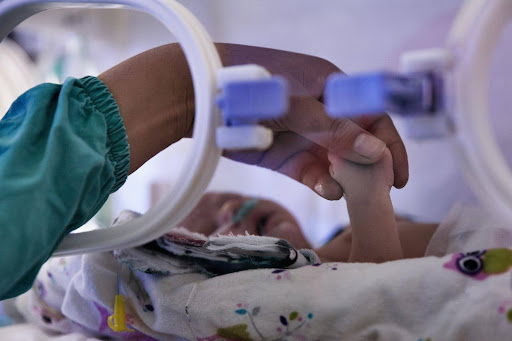
Last year, the Anabah facility safely delivered over 7,000 babies, providing families with prenatal, birth, and postpartum care and triage appointments at no cost to patients. The hospital also provides pediatric, adult surgical, rehabilitation, and neonatology services all free of charge. Compared to the national statistics, EMERGENCY’s facilities have significantly lower maternal and infant mortality rates. Despite a lean budget, Dr. Michele Usuelli, EMERGENCY’s director of Neonatal Services, attributes this success to a combination of factors: human resources, communication, infection control, and technology.
Human Resources
“Investing in [local] human resources is the single most important indicator of success,” Usuelli said. He emphasized that national nursing staff are crucial to patient care. “There is a 1 to 3 nurse to neonate ratio in the NICU and 1 to 2 in the isolation unit.” That ratio allows for the implementation of advanced lifesaving interventions such as CPAP, intravenous fluid administration, and phototherapy.
“The nurses are also vested in patient outcomes,” Usuelli said. He said they have an ability to build relationships with mothers that men aren’t able to do because of Islamic and cultural restrictions. For example, they teach mothers how to breastfeed, and when newborns have conditions incompatible with life, the nurses are present with the families when discussing palliative care. They provide compassionate support to the families through the bond they build when caring for the newborns.
Finally, EMERGENCY believes that developing a strong local health workforce is the only way to build a long-term, sustainable health system – one that contributes to the local economy and enables patients to connect with and be treated by those with similar linguistic, cultural, religious backgrounds. With around 97% local staff, these hospitals are run by and for the Afghan people. Yet Dr. Usuelli worries about the current educational restrictions, and how to tackle the inevitable future workforce shortages.
Communication
Communication between different teams, such as midwives and NICU nurses, is critical for continuity of care and can influence medical management. “The patient may have PROM [premature rupture of membranes]. . . but for how long and how many doses of antibiotics the mother received determines how we treat the baby,” Usuelli gave as an example.
As is the case in the U.S., obstetrics, anesthesiology, and neonatal teams cooperate extensively to increase survival rates. According to Usuelli, the interdisciplinary team includes pharmacy, laboratory, X-ray, biomedical, and onsite blood bank departments. Those shared services support the medical teams throughout the hospital.
Furthermore, the mothers themselves play a critical role in outcomes. EMERGENCY provides clothes, food, and housing for the mothers of newborns so they are able to breastfeed every two hours and provide other forms of care for their newborn in one of the stepdown units. “It helps increase the milk supply for when the babies are discharged because many do not have financial resources for supplementing,” Usuelli explained. “The nurses also spend time educating mothers on danger signs, so they know if they need to bring their children back after discharge.”
The organization is developing relationships with other agencies to address systemic issues such as malnutrition. Often, birth is the only time some families might seek medical attention. EMERGENCY hopes to take advantage of this window of opportunity to connect patients to available resources.
Infection Control
Premature infants are particularly at risk if exposed to infections so standard precautions are taken. Currently, blood cultures are unavailable at the onsite laboratory due to the cost benefit ratio. Instead, based on specific criteria, babies will receive a course of antibiotics as prophylaxis. The same applies to other patients. For example, mothers who have specific risk factors will receive prophylactic treatment. The mothers are also taught about hygiene including the importance of hand washing to prevent the spread of infection.
Furthermore, the cesarean rate is about 7% which is significantly lower than the American average of 32.3%, according to the National Center for Health Statistics. That reduces risk of infection. It also ensures that future pregnancies are safer since each subsequent caesarean increases the risk of complications to mothers.
Technology
The organization seeks to integrate technologies that are financially sustainable long term and show positive impact on mortality and morbidity rates. Usuelli noted that any new technology or procedure is evaluated thoughtfully as well as introduced into practice strategically and methodically. “Many low-resource countries have equipment donated to them, but it goes unused,” he said. “Our biomedical team participates in all decisions to ensure that the product can be maintained and any necessary modifications to existing infrastructure is considered.”
The organization also invests in proper training of staff to ensure competence in using the equipment and interpreting results. “There are some decisions that need to be made because of being in a low-resource setting [and best allocation of funds],” said Usuelli.
As an example, recently, the hospital invested in cardiac ultrasound training rather than mechanical ventilation in NICU. “Some of the [more impoverished] families don’t have the resources to care for a severely disabled child long term, but cardiac anomalies can be referred for surgery with good outcomes if identified early,” said Usuelli.
Not all technology requires significant capital investment. For example, digital scales are used to more accurately see the trend of newborn weight gain. “It’s simple, but effective,” he said.
Based on these factors, NICU babies over 1500g have close to a 100% survival rate at Anabah, adjusting for conditions incompatible with life. That compares with any high-resource country. Usuelli said that families travel from Kabul or beyond because of the hospital’s reputation.
Beyond maternity and neonatology, pediatrics is also running at capacity. Dr.Juozapaite is evaluating case data to determine where best to allocate resources in her limited spare time. “I’m a physician and want to focus on patient care,” she said. But this analysis is critical to identifying where to expand services – an important factor to convince donors to support the organization’s ongoing mission. “It’s hard to focus on how many children we help when we lose some [due to the extenuating circumstances of post war realities] or have to refer others daily [because of funding limitations].”
Her life’s mission is to see as many children as possible have a chance to grow up and contribute to the future of Afghanistan and in the meantime, create a little mischief as healthy children do. EMERGENCY has shown its commitment to make that happen not only in Afghanistan, but other places around the world.
Romy Sharieff is a licensed midwife and founder of the Bryan J Westfield Scholarship. She can be contacted at romysharieff@yahoo.com.