Shifa Saltagi Safadi on Writing Authentic Muslim Protagonists
By Amani Salahudeen
Jul/Aug 26
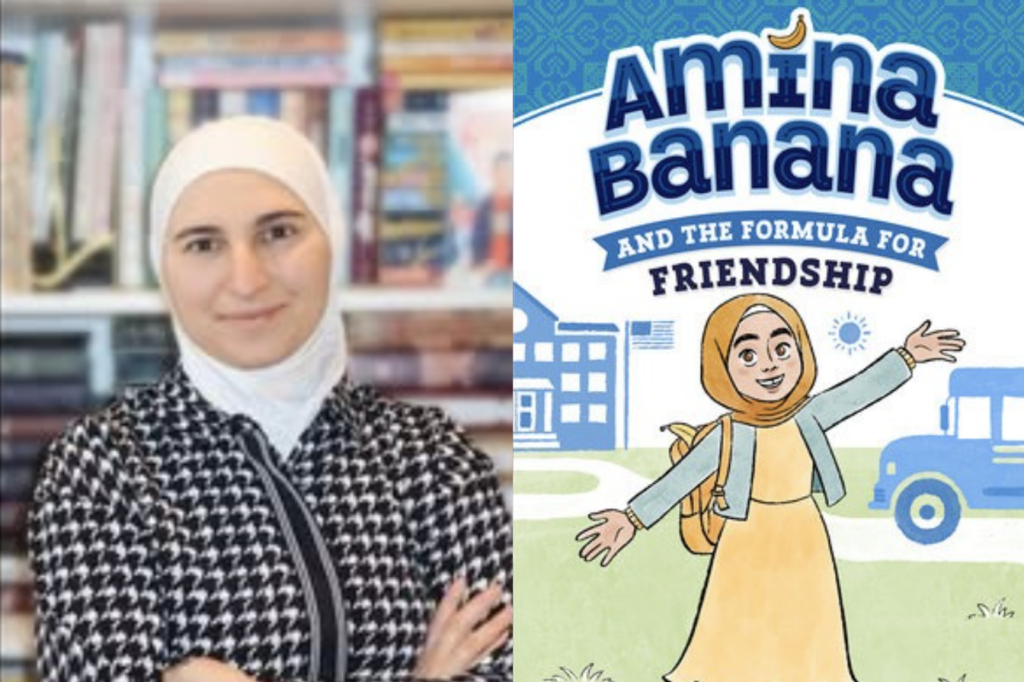
Author Shifa Safadi, 36, got her start as a Muslim book reviewer with her blog, Muslim Mommy. Today, she is well known for her own books that help immigrants and Muslim Americans feel seen. She holds a bachelor’s degree in English Literature from Indiana University Northwest and offers a thoughtful blend of culture, humor, wisdom, and lived experiences in her books.
Safadi is the author of the National Book Award-winning young adult novel Kareem Between and the middle grade Amina Banana series as well as numerous picture books. Her stories highlight her Muslim identity, immigration experiences, and the awkward feelings that come with trying to fit in. Safadi, a bilingual Arabic-English speaker and a former English teacher, was born in Syria and immigrated to the U.S. with her parents when she was a young girl.
She currently lives in the Chicago area with her husband and children. As a mother and educator, she is committed to creating stories where Muslim children — especially those from immigrant or refugee backgrounds — can see their lives, friendships, and struggles portrayed with authenticity and empathy.
Although Safadi’s stories center Muslim and immigrant challenges, she also helps others understand these stories through her books. Safadi highlights the importance of navigating friendship through the lens of her protagonists.
Islamic Horizons interviewed Safadi about her work.
Islamic Horizons: Why do stories about Muslim friendships matter, and what inspired you to explore this theme in your work?
Shifa Safadi: Growing up, I often felt like I was not going to fit in anywhere because [my family] moved a lot and it was always difficult for me to make friends. There were times that led me to falling to peer pressure and doing things I knew were wrong – like giving my lunch money up or letting people bully others in front of me – to fit in with the popular crowd. Peer pressure can lead to bad choices if you are not careful, especially for kids.
As a young teen, I was scared to seem different. I wanted kids [and adults] who read this to be empowered by this to stand up for themselves too. Books offer lessons in showing character change from [being] flawed to being better through a plot. Kareem does this in an engaging way so kids feel swept away by the fictional football story, rather than preached to in a didactic lesson.
IH: How does your personal experiences shape the worlds and characters that you create?
SS: I have always written as a way to express my feelings. I have always loved to write, read, and journal. So, writing is my personal experiences put into characters, but in a fictionalized way. With Kareem Between, [it shows up as] his experience growing up as a Syrian American. . . trying to figure out if he can belong in America as a Muslim when he faces Islamophobia and trying to figure out if he needs to hide parts of himself in order to fit in such as his name, food, or language.
I often wondered, “Do we belong here? Can I make a life here?”
There’s something that a lot of immigrant kids do called code-switching. For example, when I went to school I would try to speak English perfectly, try not to be too loud or obvious. Not because I was ashamed of who I was but because I was worried about standing out. When I was at home I wanted my Arabic to be perfect to talk to my parents. But the more my English improved, my Arabic [began to diminish]. You feel more disconnected to the country that you came from after living in the U.S. for some time. Kareem Between delves into what it means to be a Muslim, especially [as] a Syrian American Muslim. Amina Banana is based [on] my experience trying to learn English and [find] friends. Both are tailored to that age group. I started off centering trauma: that feeling of not belonging, feelings about the Muslim ban, anxiety, and mental health.
The more I write, the more I am also finding topics of joy. I have a picture book coming next year called The Ka’bah Cat. I am so excited to draw on all aspects of my life so [I can portray] both the hardships and the joy through my books.
IH: How do you balance authenticity and making sure your work is still appropriate for young readers?
SS: An editor mentioned something that I’ve carried with me through my writing journey: “Through the ocean and sea of issues that a character navigates you have to provide them with a boat for them to be able to float, for them to be able to sit and carry the reader through the story.” If a story is too sad or hopeless then readers will be left with a feeling of sadness rather than hope by the end of the story.
My intention is to create hope. There are so many moments of hope, joy, and silliness. [Muslim stories] are not only about trauma so I intend to balance my stories with both hardships and joy.
In my Amina Banana series, she realizes that there are things called idioms where American sayings [don’t mean] what they say. For example: “It’s raining cats and dogs!” She becomes confused because she doesn’t understand why people don’t say it’s raining hard. She realizes that there are Syrian idioms and symbolism in Islam as well.
IH: Do you cater more towards Muslims or to a general audience for your social media platforms?
SS: When I was a book reviewer, I catered more towards the Muslim audience. Now that I am an agented author, I cater it more towards the general audience but still use Islamic phrases such as InshaAllah or Alhamdulilah. I don’t like to hide who I am or censor my posts in that regard. I also show that. . . my books are for everybody as well.
IH: What does ‘between’ mean to you in the context of Kareem’s journey?
SS: I wanted to talk about a Muslim American who feels stuck between two cultures because that is Kareem’s main journey. I named him Kareem because it sort of rhymed with “between.” I wrote this story with the intention of talking about this “between” identity many Muslim American immigrant kids go through. I wanted to show readers that it is okay to be between. You can be Syrian, American, and a Muslim.
IH: How does Amina change as a result of her friendships?
SS: Amina has to learn that the true formula for friendship is kindness, and her character is helped by so many examples of friends who show that kindness to her first. Fatima welcomes her in the [mosque] and tells her that Americans can look different and be different. Crystal welcomes her and sits next to her on the bus, standing up for her and explaining idioms that confuse Amina. Her bully, Tara shows her what friendship does not look like – it does not look like being mean. Her group of friends makes an impact on her in every book and teaches her the true meaning of community.
IH: What lessons can young readers take away from Amina?
Safadi: Amina is a story of joy and resilience. There are so many entry points into Amina Banana. One is through normalization of a loving Muslim family, which we hardly ever see in literature or media. This normalization of hijab, salah, dua’a, Islamic weekend school, and hadith helps humanize Muslim practices and reduce the fear that seems to surround us. Amina loves her faith so much, and it will help Muslim readers feel seen too.
IH: What’s one of your future goals?
SS: One of my future goals is to write mysteries for Muslim kids. There aren’t that many Muslim mysteries out there.
IH: What is your main advice for young Muslims who want to be authors one day?
SS: Read a lot in [your] genre of interest and take writing courses. Writing is almost a science because there are so many elements that you have to think about. Practice writing as well.
Amani Salahudeen has an M.A. in English Education from Western Governor’s University and a B.A. in Journalism and Professional Writing from TCNJ. She is currently an elementary school English teacher.
Want more like this? Subscribe to the Islamic Horizons magazine and support authentic journalism by Muslims for Muslims.