Can Muslim Households Successfully Create Environments Where Faith and Western Life Coexist Without Contradiction?
By Hamza
Sept/Oct 26
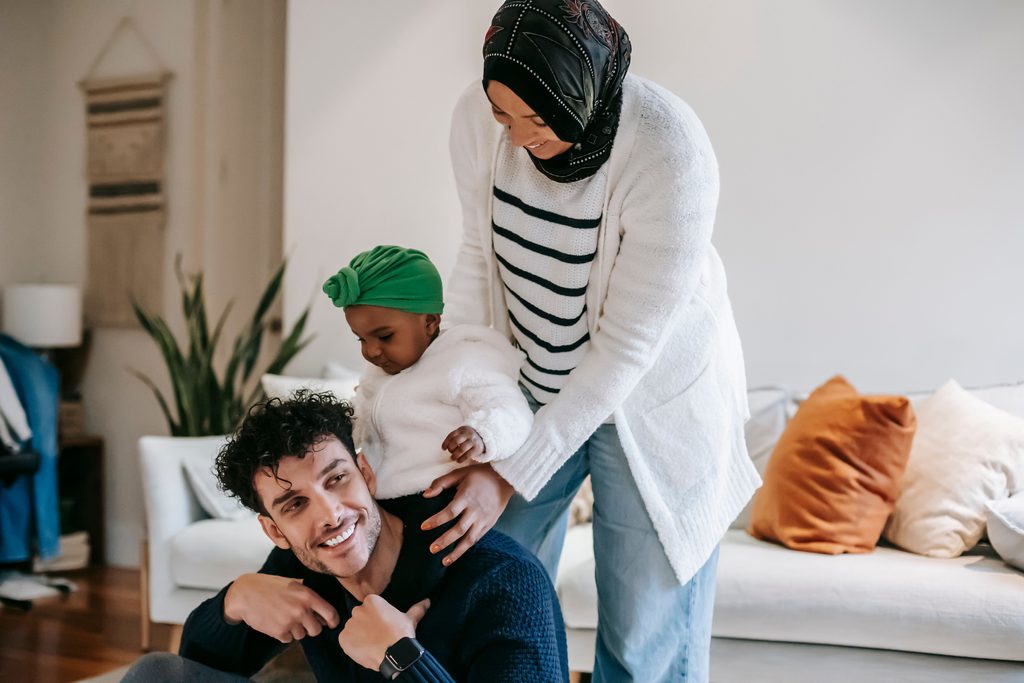
There is a pressure that exists in immigrant Muslim households in the West. Sometimes, it exists quietly in dinner table conversations, in arguments over clothing, in the silence between parents and children who both love each other but no longer fully understand one another. It is the pressure of trying to preserve something while living inside a society that constantly reshapes identity.
For many Muslim families, raising children becomes more than parenting. It becomes preservation.
When Identities Collide
Muslim parents in the West are often balancing two fears at the same time. One fear is losing their children to the surrounding culture. The other is damaging their children through excessive control. Between these two fears exists a constant tension that shapes many Muslim households.
Many immigrant parents arrive in the West carrying memories of home. They remember communities where religion was embedded into daily life. Islam was not something that had to be defended every day because it surrounded them naturally. In the West, however, many parents feel that faith must be actively protected. What was once embedded in the cultural atmosphere suddenly becomes a conscious effort.
This effort, however, often relies on methods that no longer fit the moment. Mohammed*, a community leader in Dallas who works closely with Muslim families, and who asked to remain anonymous, believes this is where much of the strain begins. “The greatest challenge comes from the fact that parents are trying to raise their children the way they were raised,” he said. “What worked a long time ago does not necessarily mean it will work today.” Approaches built on pressure or criticism, he explained, tend to push children further away rather than draw them closer.
In 2017, the Pew Research Center found that Muslim Americans overwhelmingly identify as both Muslim and American, with nearly nine in 10 saying they are proud to hold both identities simultaneously. This balance is often harder within the home itself. Parents and children may technically share religion, language, and family, but they experience society differently. The parents remember migration. The children remember school cafeterias, social media, and trying not to feel different.
This creates a cultural gap that is deeper than language alone. In many homes, parents speak from memory while children speak from experience. Parents compare life to the country they left behind. Children compare life to the classmates around them. Both perspectives are real, but they often collide.
Dr. Rezwan Khan, a board-certified adult and geriatric psychiatrist, frames this divide with compassion. “The generational gap often stems from different life experiences rather than a lack of love or respect,” he said. Parents carry the memory of the societies they left behind, while their children grow up in an entirely different environment. Misunderstanding arises, he noted, when either side assumes the other should see the world the same way.
Language, Media, and Division
One of the clearest examples of this divide is language itself. Many second-generation Muslim children slowly lose fluency in their parents’ native tongue over time. But language is not only communication; it is emotional inheritance. Once language weakens, certain emotions, jokes, and traditions become harder to transfer. Grandparents become more distant. Stories lose texture. A child may still love their culture while no longer fully understanding it.
At the same time, Muslim children in the West face pressures their parents often did not experience growing up. Young Muslims today are not only navigating school and family expectations; they are also navigating algorithms, influencer culture, political polarization, and constant public discourse around Islam. A Muslim teenager may feel pressure to represent Islam perfectly while also wanting the freedom to simply be young.
Mohammed sees the same pattern in the families who come to him. Beyond social media, he pointed to a wider landscape of exposure that many parents feel unprepared to address. “Parents are not equipped,” he said. “They don’t have the education or the awareness to deal with these kinds of situations.” The result, he explained, is that parents are often reacting to a world they never had to navigate at their own children’s age.
This pressure becomes especially heavy after moments of public tension involving Muslims. Many Muslim children grow up aware that their religion is constantly discussed politically. This creates a defensive posture from an early age. Some children become more religious as a result, while others distance themselves from faith because they associate it with scrutiny, conflict, or restriction.
A younger perspective makes this tension vivid. Ahmed*, a Muslim recording artist who grew up in the West, and who asked to remain anonymous, described the experience as sitting in two rooms at once. “You’re [in a room where you’re] supposed to be a certain kind of son, a certain kind of Muslim, a certain kind of ‘good’,” he said, “and [in] another room where you’re just trying to be a kid who wants to exist without explaining himself.”
Ahmed did not resolve that pull so much as learn to live inside it. “I built something in between — almost like wearing a mask that let me move through both worlds without losing either one.” What shaped him most, he said, was not choosing a side but the quiet that surrounded him. “Not talking about what we’re feeling, not making our parents worry, not giving the culture more ammunition to stereotype us — that silence shaped me more than any single decision.”
Parents respond to this environment differently. Some become stricter in order to protect their children from perceived moral decline. Others become more flexible out of fear that excessive pressure will push their children away entirely. Both responses usually come from love, but both can also produce unintended consequences.
Finding the Balance, Creating the Bridge
Studies on immigrant family dynamics frequently show that second-generation children acculturate faster than their parents, leading to conflict over values, autonomy, and identity. This is especially visible in discussions around marriage, gender roles, friendships, career choices, and religious practice. Parents may interpret independence as rebellion, while children may interpret protection as distrust.
These tensions surface most clearly in what parents fear losing. The worries Mohammed hears most often are strikingly consistent. “Parents worry most about what will happen to their children when it comes to marriage,” he said, “and whether their kids are going to stay on this deen or not.” Underneath those concerns, he observed, is a generational difference in how effort and responsibility are understood — parents who worked hard to build stability, and children who did not witness that struggle firsthand.
What the children themselves carry often goes unspoken at home. Mohammed said young people frequently confide struggles they would never raise with their parents. “What young people tell me is that they’re struggling with their faith, struggling with their iman [the sincerity of their faith], and struggling to communicate with their parents,” he said. Part of the breakdown, he suggested, is that honesty is met with alarm rather than patience. “If parents even hear something slightly unpleasant from their kids, they lose their minds.” Over time, children learn that silence feels safer than truth.
This is where Khan’s clinical experience comes in . He urges parents to reverse the instinct to correct before they understand. “Listen first, lecture less,” he advised. “Be warm but firm — love and boundaries together.” The home, in his view, should become “a place for respectful discussion rather than fear of punishment” where a child can voice doubt without fearing that the relationship itself is at risk.
Khan pointed to what the West can offer when it is paired with faith. “The United States offers tremendous opportunities for education, personal growth, and critical thinking,” he said. “When these strengths are combined with a strong Islamic foundation, young Muslims can become compassionate leaders.” Mohammed echoed this from a different angle, emphasizing stability. “You have to respect that this country does offer a certain level of safety,” he said, “and the kids benefit from that.”
In many cases, Muslim families in the West produce children who become bridges between worlds rather than victims of them. They learn how to translate cultures for their parents while also explaining their parents to wider society. This can create emotional exhaustion, but it can also create maturity and empathy at a young age.
Embracing the Silence
For many young Muslims, the silence they grow up with eventually finds another outlet. Ahmed believes art becomes the place where they finally say what they have carried since childhood. “You can’t always have direct conversation at the dinner table,” he said, “but you can put it in a verse, in a visual, in a tone. Music lets you process contradiction without needing permission first.” He sees it less as rebellion than as being witnessed. “A lot of us grew up watching our parents carry entire histories of migration and sacrifice quietly, and we inherited that instinct to stay quiet too,” he said. “Art breaks that pattern.”
The deeper issue is that many Muslim families are trying to answer a question larger than parenting itself: what deserves to survive across generations? Every argument about clothing, language, friendships, or religion is often really an argument about continuity. Parents fear that once certain traditions disappear, the family itself will slowly dissolve into individualism and forgetfulness.
Yet children are not museums. They cannot simply preserve culture unchanged. Every generation adapts inherited identity to its own time and place. The challenge is not whether Muslim children in the West will change. They inevitably will. The challenge is whether that change happens through understanding or through fracture.
The healthiest Muslim families are often not the ones with perfect obedience, but the ones where communication survives disagreement. Children who feel heard are more likely to remain connected to faith and family over time. Likewise, parents who adapt without abandoning their principles often preserve deeper trust with their children.
Khan’s guidance reinforces this. He believes faith endures not through enforcement but through relationships. “Faith is transmitted most effectively through consistent love,” he said. He also encourages parents to watch for the quieter signals — shifts in a child’s mood, behavior, or social patterns that may mark the early signs of distress — and to respond with presence rather than punishment. Above all, he wants young Muslims to hear one message from the adults around them: “You can be Muslim, American, and successful.”
Ahmed emphasized connection rather than control. “To parents, I’d say the goal was never obedience, it was always connection,” he said. “If your kid feels safe enough to disagree with you and still come home, you didn’t lose them. You kept them.”
To young Muslims, he offered a reminder to extend the same understanding upward. “Your parents aren’t the culture you’re trying to escape — they’re the first generation trying to survive it. A lot of what feels like control is actually fear dressed up as rules.” The distance between them, he suggested, is often a matter of translation. “They’re just scared in a language you were never taught to translate. Learn it anyway. That’s where the bridge gets built.”
Raising Muslim children in the West therefore is an act of negotiation between memory and reality. Parents carry inherited worlds. Children inherit fragmented versions of those worlds while trying to build identities of their own. Neither side fully controls the outcome.
What remains important is sincerity. Many Muslim parents sacrifice comfort, homeland, and familiarity so their children can have opportunities they never had themselves. Many Muslim children carry invisible emotional burdens while trying to honor both faith and belonging. Beneath the arguments and misunderstandings is usually the same desire on both sides: dignity, stability, and meaning.
The cultural gap is real, but it is not insurmountable. If approached with patience, humility, and honesty, it can become less of a wall and more of a bridge between generations.
*Names have been changed for privacy reasons.
Hamza is a writer and researcher and the founder of Nascent Oasis. His work explores Muslim history, culture, media, and social issues with a focus on fostering understanding through storytelling. He is passionate about highlighting overlooked narratives and the contributions of Muslims to global civilization.
Want more like this? Subscribe to the Islamic Horizons magazine and support authentic journalism by Muslims for Muslims.