Rebuilding Palestine One Student at a Time
By Sandra Whitehead
May/Jun 26
After more than two years of relentless Israeli bombing and ground operations in Gaza that destroyed homes, hospitals, schools and universities, roads and infrastructure, and left behind mountains of rubble, talk about reconstructing Gaza has finally begun. World leaders met in Davos, Switzerland, in January to view U.S. plans for reconstruction featuring glitzy skyscrapers and high-end hotels. At the same time, and more practically, the United Nations Office for Project Services declared it was ready and able to help clear rubble, restore energy, manage waste, and provide shelter for the approximately 2 million internally displaced Palestinians in Gaza.
The Palestinian Student Scholarship Fund
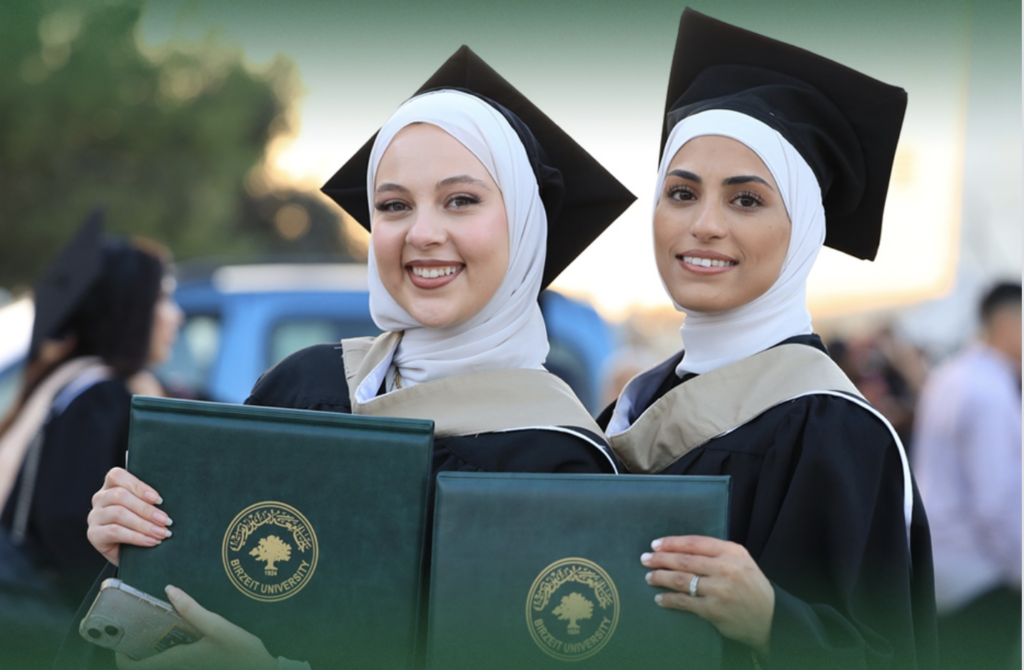
Meanwhile, a dedicated group of Palestinian Americans is pursuing its own plan — to rebuild Palestine one student at a time. The Palestinian Student Scholarship Fund (PSSF), a volunteer-run nonprofit, is doing what it has done since 2017 — investing in the education of Palestinians. Since its founding, PSSF has funded more than 3,300 scholarships to Palestinian university students.
“We know Palestinians need food, shelter, and medicine. Fortunately, many humanitarian organizations have stepped up,” PSSF Founder and President Ali Ata told Islamic Horizons. “That need is immediate, but it’s short term. Education can’t take a back seat. In the long run, education is the ticket to a better future.”
PSSF members believe education is the most powerful tool for transforming individuals, communities and nations. Education creates future doctors, engineers, educators, and advocates who will help strengthen their communities for generations to come.
“[Education] is not only our vision, but also our history, our culture,” Ata said. “In 1948, Palestinians became refugees in camps throughout the region. Even at that time, they were more advanced in education than most.”
Ata said a Palestinian family would go hungry for their child to go to school. Once their education is complete, that child would go out and work in the Gulf states and send money back to their family. That money would go towards their siblings’ education and soon, the whole family would be educated.
Yet scholarships, important as they are, are not all that PSSF gives Palestinian students. “We’re a hands-on board, going there and listening to the students,” Ata said. “Whatever we come up with is not based on theoretical needs; it’s based on what students live through. Input from the Palestinian students helps PSSF evolve and develop better programs each year.”
Launching PSSF
PSSF was conceived when five Palestinian American friends met to talk about how they could help their homeland. “Many great organizations do good work [to help Palestinians],” Ata said. Some support certain villages or towns. Many aim to provide much-needed medical care, food and other basic needs. Most, if not all, use some of the money they raise to finance their operations. “We wanted to differentiate ourselves.”
In addition to focusing only on education, PSSF ensures that 100% of donations are delivered to the Palestinian people. “If you go to a donor and tell them 100% of your money will be delivered, that will appeal to people,” Ata said.
PSSF’s founders are committed to volunteering their time and paying 100% of their organization’s operating costs – pledges that the board continues to honor. They keep separate books and bank accounts for scholarship donations and operating expenses and publish financial statements every year on their website.
Board members pay the salary of a part-time staff member and the travel expenses for their fundraising trips around the United States. They also pay the costs to attend an annual convention at a Palestinian university where they meet with students and leaders of their partner universities. In May, they are convening at Bethlehem University, a Catholic institution in the Lasallian tradition.
Board members also contribute a significant portion of the funds raised for scholarships. “I was so impressed by how much time and money the board members each invested in supporting the organization and meeting with the students. That’s what made me want to join,” said new PSSF board member Sheila Badwan.
This small but dedicated band of Palestinian Americans eager to serve Palestinian students inspired others to join them. Ata said that in a decade the organization went from supporting 50 students at one university for $100,000 per year to supporting 1,000 students at 10 universities for $2 million last year.”
More Than a Scholarship
When PSSF board members visit Bethlehem University in May, they will hear firsthand what it means to Palestinian students to have the opportunity to study, said Nesreen Darwish, a board member who coordinates the annual trip and the daughter-in-law of PSSF founding memberAmir Darwish.
“I’m here to change the path of my family’s future,” an 18-year-old Palestinian student told board members last year. The fifth-generation farmer and his family were no longer allowed to plow their own fields. His grandmother was afraid settlers would harass her if she went to their property to pick grape leaves.
“Because of PSSF, I will learn to be a businessman and get a regular job,” he told the visitors from PSSF.
Darwish also recalled meeting a pharmacy student from Gaza over a Zoom call. “He said, ‘Hey, we’re here. We barely have food. We barely have water, but if we don’t study, we have no hope for our future,’” she said. “You can take a lot of things away from people, but you can’t take their minds, and their ability to read and educate their families.”
According to Darwish, the PSSF serves 4,000 students from Gaza who take online classes in the West Bank. She said that though universities and schools were among the first institutions bombed in Gaza, many Palestinians are determined to continue their education. “ “It’s not the building that’s giving you the education. It’s the people,” she said.
On rare occasions, PSSF’s Palestinian students have been able to visit the U.S. and share their stories, Darwish noted. Kareem Hijazi, a law student at Jerusalem’s Al Quds University, visited in September last year, to speak at PSSF fundraisers in Chicago and Milwaukee. He and a medical student at Al Quds won PSSF’s Strength and Strive Award for a tutoring program they developed. His project partner was not able to attend because the U.S. did not grant her a visa, Darwish explained.
“We created the award last year to encourage PSSF scholarship students to consider how they can, in turn, contribute to the homeland,” Ata said.
The organization also offered the Innovation Award won by a student who created a new, eco-friendly, lightweight, yet exceptionally strong type of concrete. Both awards included additional financial support.
“What we can offer is not only financial support but life experience,” Ata said. “We can help promote leadership. At the end of the day, you want to graduate not only doctors and engineers, but you also want to graduate leaders who will take on the responsibility of building the society and the future of our people.”
Hijazi recorded a message for PSSF while he was in the U.S., describing the experience of being a student in Palestine. In it, he said,
“It feels like carrying the weight of family responsibilities while chasing grades that decide scholarship and future. It feels like choosing between buying a textbook or paying for transportation, between staying late on campus or getting home before it gets dark. It feels like studying through grief, through uncertainty, through headlines that sit on your chest while you try to memorize case laws or chemical equations.
“Sometimes it feels like you must be made of iron to just be ordinary, and yet students keep showing up. They show up with notebooks, with bruised hearts. They show up with coffee that tastes like bravery. They show up because every lecture is a small refusal to give up.”
This is what the PSSF protects.
Sandra Whitehead, Ph.D., is the lead reporter for the Wisconsin Muslim Journal. She is also an author and educator in Milwaukee.
Want more like this? Subscribe to the Islamic Horizons magazine and support authentic journalism by Muslims for Muslims.