The Complexity of Being an American Muslim
By Nawal Ali
Mar/Apr 26
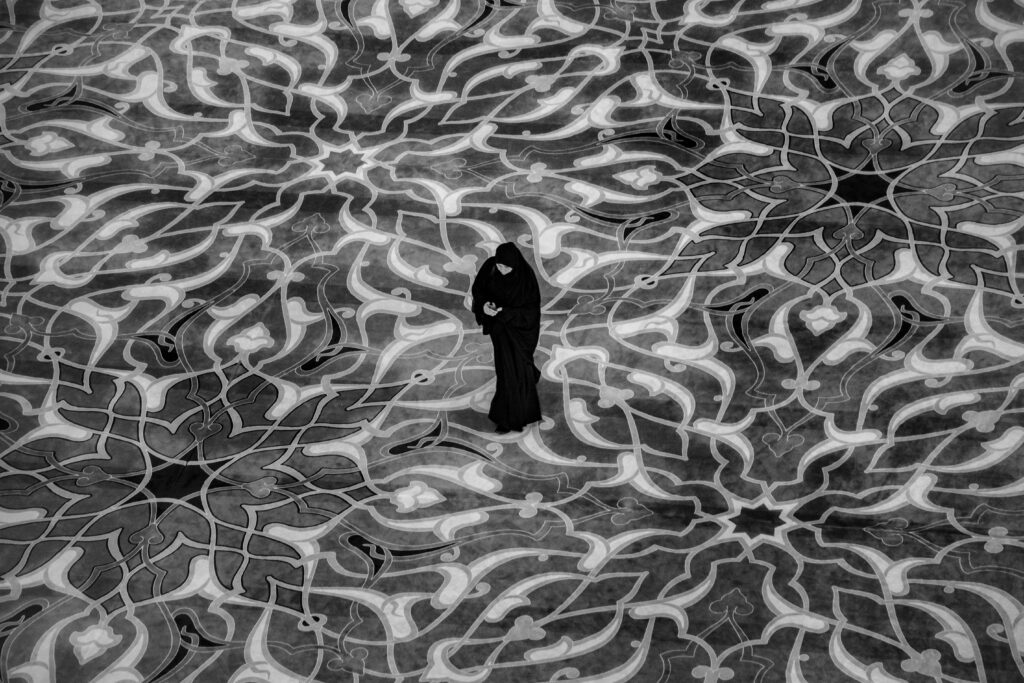
American Muslims represent a small but significant portion of the country’s population. While many Muslims, especially Black Muslims, in this country trace their lineage to the slave trade, there exists another demographic that remains inadequately explored: children of immigrants from Muslim countries with eastern and western identities.
My childhood was defined by this duality. I was expected to honor my family’s heritage while simultaneously embodying the American experience. Despite being born and raised in the United States, I was placed in English as a Second Language (ESL) classes. My parents believed in the preservation of their language at home, even if it meant their American-born child would struggle upon entering the school system. This cultural choice set the stage for a lifetime of questions about who I am and where I truly belong.
The ESL classroom represented my first encounter with institutional categorization. I was grouped with students who had recently immigrated, despite never having lived anywhere but the U.S. The distinction was lost on the education system: we all spoke limited English, therefore we all occupied the same space of foreignness.
The Performance of Heritage
During the 1990s, American schools embraced multiculturalism. Heritage days became common to honor the varied backgrounds representing the students in our classrooms. While I understood the well-intentioned effort, the execution revealed a fundamental flaw: these attempts actively demarcated difference rather than creating genuine inclusion.
I remember standing before my classmates, presenting information about a country I had never visited, describing traditions I had never practiced, and representing a culture that existed for me only in fragments. My parents left their homeland as young adults and yet I was tasked with being an ambassador for a place that even my own family had no desire to revisit.
Meanwhile, my white classmates were never asked to perform their heritage in this way. Their Americanness required no qualifier, no explanation. Their immigrant histories — Irish, Italian, German, French — had been absorbed into the unmarked category of simply “white” or “American,” while mine remained perpetually othered.
Navigating American Perceptions
As I matured, I became increasingly aware of how Americans perceived me despite my citizenship and birthright. My father, despite his pronounced accent, was often assumed to be one of them. People would engage with him warmly, making assumptions about his Italian heritage due to his olive skin and colored eyes. When I entered the room though, the dynamic shifted.
One incident in particular crystallized this perception of bias. While out with my ex-husband, a phenotypically white-passing Lebanese man, an elderly woman struck up a friendly conversation with him. When inquiring about his home state, he responded directly: “I’m Arab. I’m not from here”
“That’s impossible. Arabs are dark,” she stated.
Eventually the conversation turned to my background . As my ex-husband clarified that I was the American, she expressed, “If I had not seen you, I doubt I would’ve even talked to your wife because I’d assume she can’t speak English.”
My belonging was conditional, mediated through an adjacent whiteness that legitimized me. I was acceptable only when vouched for by someone who looked “American,” whatever that meant.
The Invisible Labor of Cultural Translation
The experience of being an immigrant’s child involves a form of labor that remains largely unacknowledged in American discourse. These children become simultaneous inhabitants of two worlds, serving as interpreters not merely of language but of entire cultural systems.
They accompany their parents to medical appointments, translating symptoms and diagnoses they barely understand themselves. They attend parent-teacher conferences as intermediaries, bridging not just linguistic gaps but fundamentally different educational philosophies. They complete forms, communicate with insurance companies, and wrangle with government agencies while still in the midst of their childhood.
This translation work extends beyond practical matters. Immigrant children become cultural interpreters, explaining American social norms to their parents while simultaneously trying to practice those norms themselves. They learn to code-switch, adopting different personas depending on social context.
The psychological weight of this responsibility is rarely discussed. These children sacrifice elements of their childhood to serve as bridges between their parents and American society. They mature quickly, shouldering adult burdens while their white peers remain completely unburdened by such weighty responsibilities.
This dual existence creates a particular kind of fragmentation. Immigrant children learn early that they must be multiple people simultaneously: dutiful children at home, assimilated Americans at school, and cultural ambassadors in public. The coherent sense of self that others take for granted becomes something that must be constantly reconstructed depending on audience and context.
The Search for Identity
At 16, I eventually sought belonging abroad, hoping that international travel might offer a different dynamic. Instead, I encountered intensified versions of the same assumptions. Across Europe, Asia, and the Middle East, when I identified as American, it was often met with confusion. “That’s impossible,” people would say. “Americans are white.”
And the question came constantly, “Where are you REALLY from?”
That single word, “really,” carried profound implications. It suggested my initial answer was insufficient, inauthentic, or otherwise incorrect. It implied there existed a deeper truth about my identity that needed excavation.
I struggled to answer that question because I had no other identity to claim. Beyond language, almost nothing of my parents’ homeland existed in my upbringing. And when I tried to embrace my parents’ heritage, people who actually came from those places would dismiss me. Then another problem surfaced: how far back do I trace my roots when even my grandparents came from different places than my parents?
For years, I sidestepped these conversations entirely. Only later did I understand that this wasn’t a personal failing but a symptom of larger structural forces creating a distorted perception of what it means to be American.
Whitewashing
Media representation has profoundly shaped global perceptions of American identity. The television shows of the 1990s — Friends, Seinfeld, Full House — dominated American cultural exports. And yet despite taking place in diverse urban centers within the U.S., these programs featured almost exclusively caucasian characters, teaching global audiences that “American” was synonymous with “white.”
This pattern persists today. Muslim characters in contemporary media typically appear as terrorists, oppressed women requiring rescue, or recent immigrants struggling with cultural adaptation. Always Arab-American, Indian-American or even Native American. Rarely are we depicted as simply existing as Americans living ordinary lives.
These media narratives also intersect with how American history is taught in schools. The whitewashing of American history is so comprehensive that most Americans fail to recognize it as distortion. The dominant narrative celebrates European immigrants who arrived seeking opportunity and built a prosperous nation. The genocide of Indigenous peoples is dismissed as an unfortunate historical footnote. The foundational role of enslaved labor and stolen land in generating American wealth is treated as a side story.
This historical erasure enables white Americans’ unmarked status. When traveling abroad they rarely feel compelled to discuss their immigrant origins, partly because they are never asked, but also because they have conceptualized themselves as simply American. White American culture has systematically eliminated Indigenous representation from its national narrative. European colonizers claimed an identity that was never theirs while committing genocide against the original inhabitants of the land.
Reclaiming the Narrative
Although I do blame white America for creating this dynamic, I recognize that the world is also ignorant. The colonized backgrounds of some keep them submissive to the words of their oppressors. In other cases, it relates to how their own communities conceptualize belonging. Some cultures operate through ethnic categorization systems. America, despite its many failings, operates theoretically as a civic nation rather than an ethnic one.
I have begun responding differently when questioned about my origins while traveling. When asked where I am from, I state: “America.” When pressed, I pose my own question: “What do you believe Americans look like?”
This reversal disrupts the expected script. It forces my questioner to examine their own assumptions. When they inevitably answer “white,” I challenge their ignorance. I explain that white Americans are descendants of colonizers, while people of color share greater proximity to this land’s original inhabitants. There are no authentic Americans except Native Americans, the Indigenous people.
I refuse to continue justifying my existence. The question is not where I am “really” from but rather why people assume American identity has only one appearance. When will they recognize that the face they seek never legitimately belonged here to begin with?
What remains certain is this: I am not diminished as an American because I wear a hijab. I am not less American because my parents speak another language. I am not less American because others assume I originated elsewhere. If anything, the persistent questioning of my belonging has generated my conviction about what American identity actually entails. It is not a monolithic narrative but a collection of experiences, including mine. The challenge facing our country is whether it will expand its self-conception to include those of us who have always been here, or whether it will continue to define itself through exclusions that were never legitimate to begin with.
Nawal Ali is a public health graduate from Chicago with a background in development. She is currently researching Islamic culture in Central Asia.
Want more like this? Subscribe to the Islamic Horizons magazine and support authentic journalism by Muslims for Muslims.