A Matter of Scarcity or Bankruptcy
By The ISNA Green Initiative Team
Sept/Oct 26
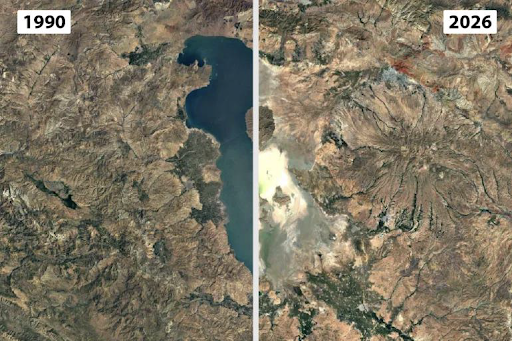
In God’s mercy, He has provided us with water, a resource that is essential for sustaining human life and for the survival of nearly all ecosystems on the planet. The Quran states, “Have you considered the water that you drink? Is it you who brought it down from the clouds, or is it We Who bring it down? If We willed, We could make it bitter. Why then are you not grateful?” (56:68).
There is a growing global scarcity of water, much of which is the result of human activities, as is the case with many other climate-related phenomena.
According to the United States Geological Survey, “About 71% of the Earth’s surface is water-covered, and the oceans hold about 96.5% of all Earth’s water. Water also exists in the air as water vapor, in rivers and lakes, in ice caps and glaciers, in the ground as soil moisture and in aquifers.”
The earth’s water supply is continuously moving from one place to another and changing from one form to another through the hydrological cycle. However, the availability of freshwater necessary to sustain human activities is extremely limited.
As above, only about 3% of the earth’s water is freshwater. Of that, only about 1.2% is readily accessible for drinking and other human uses. The vast majority is locked in polar ice caps, glaciers, and deep groundwater aquifers.
According to the United Nations World Water Development Report 2024: Water for Prosperity and Peace:
- Agriculture accounts for approximately 70% of global freshwater withdrawals, followed by industry (under 20%) and domestic use (about 12%).
- Groundwater supplies about 25% of irrigation water worldwide and approximately half of the freshwater withdrawn for domestic purposes.
- Municipal water demand has increased significantly relative to other sectors and is expected to continue rising as urbanization expands and water and sanitation systems grow.
- Roughly half of the world’s population experiences severe water scarcity for some part of the year.
- In lower-income countries, poor water quality is primarily due to inadequate wastewater treatment, whereas in higher-income countries, agricultural runoff poses the greatest threat to access to fresh water.
- Emerging contaminants include pharmaceuticals, hormones, industrial chemicals, detergents, cyanotoxins, per- and polyfluoroalkyl substances (PFAS), and nanomaterials.
According to UNICEF:
- More than 2 billion people live in countries where the water supply is inadequate.
- Half of the world’s population could be facing water scarcity as early as 2025.
- Approximately 700 million people could be displaced by severe water scarcity by 2030.
- By 2040, nearly one in four children worldwide will live in areas experiencing extremely high-water stress.
- Regions particularly vulnerable to severe water stress include South Asia, Sub-Saharan Africa, and the Southwestern United States.
Water Scarcity
There is now widespread recognition that water shortages have progressed from “water stress” to “water scarcity.” The factors contributing to water scarcity are complex and vary significantly across countries and regions. Drought, over-allocation of water resources, groundwater depletion, land and soil degradation, deforestation, pollution, and climate change are driving this crisis beyond natural climatic fluctuations alone.
Water scarcity is altering ecosystems, communities, and global markets. Climate change is also causing increasingly unpredictable rainfall patterns in many parts of the world. As a result, water scarcity has emerged as one of the most urgent global challenges, with far-reaching humanitarian, environmental, and economic consequences.
Water availability is declining across many of the world’s major food- and fiber-producing regions. At the same time, rapid urban population growth is increasing flood risks, while wetlands, rivers, estuaries, and lakes are shrinking at an alarming rate.
For example, Lake Urmia in Northwestern Iran, once one of the world’s largest hypersaline lakes, has largely dried up because of upstream water withdrawals and diversions that drastically reduce the inflow of fresh water. Climate change and prolonged drought have further worsened the situation, turning the exposed lakebed into a major source of salt and dust storms.
These trends underscore a growing reality: water scarcity is no longer a distant threat but a present and escalating crisis.
Other factors contributing to water scarcity include:
- Rising standards of living in developing countries resulting in greater per capita water consumption.
- Economic and industrial growth, which requires substantial water supplies for manufacturing, energy production, and infrastructure like the rapid global expansion of data centers.
Water scarcity is also expected to increase price volatility, particularly in agricultural markets, as demand for water-dependent commodities outpaces production. The resulting political, social, and economic risks will be especially severe for countries that rely heavily on food imports. Businesses dependent on these commodities will likewise face increasing financial risks.
Water Bankruptcy
The report “Global Water Bankruptcy: Living Beyond Our Hydrological Means in the Post-Crisis Era” published by the United Nations University Institute for Water, Environment and Health in Jan. 2026 argues that the world has already entered an era of global water bankruptcy.
Many human water systems have entered a post-crisis state in which previous environmental baselines can no longer be restored. The global freshwater cycle has crossed its safe planetary boundary. Together with climate, biodiversity, and land systems, freshwater has been pushed beyond its safe operating limits.
The report concludes that humanity is now living beyond its hydrological means and calls for a fundamental reset of the global water agenda before irreversible damage pushes more river basins beyond recovery.
Likewise, the Council on Foreign Relations report “The Global Water Crisis: Stress, Scarcity, and Conflict” states that nearly 75% of the world’s population lives in countries classified as either “water insecure” or “critically water insecure.”
The Middle East and North Africa is considered the most vulnerable global region because of its naturally arid climate and limited freshwater resources. Other highly vulnerable regions include South Asia, Sub-Saharan Africa, and the Southwestern United States.
To meet growing demand, affluent countries such as some Gulf states rely heavily on seawater desalination. Qatar, for example, obtains approximately 90% of its drinking water through desalination.
However, desalination also presents environmental challenges. The discharge of concentrated brine into the oceans reduces oxygen levels, damages marine ecosystems, and disrupts marine biodiversity.
Water Stress and Conflict
Water stress and scarcity can also contribute to violent conflict.
Many freshwater resources cut across international borders, forcing governments to cooperate to successfully manage them. Since 1948, approximately 300 international water agreements have been signed.
For example, the Senegal River Basin Organization, established in 1972 by Guinea, Mali, Mauritania, and Senegal, enables these countries to jointly manage the river’s resources.
Nevertheless, water has increasingly become a source of tension both within and between nations. For example, Ethiopia’s construction of the Grand Ethiopian Renaissance Dam has led to an ongoing dispute with Egypt over allocation of the waters of the Nile.
Similarly, India’s statements regarding the possible suspension of the 1960 Indus Waters Treaty have raised concerns that water disputes could further intensify existing political tensions with Pakistan.
What Comes Next?
The reality is unmistakable: the freshwater that sustains human civilization and Earth’s ecosystems is becoming increasingly scarce.
Recognizing the seriousness of this crisis requires all of us to use water wisely and support long-term planning to prevent future catastrophes. The UN, governments around the world, and numerous organizations are addressing this growing challenge, but the road ahead remains steep and difficult.
Part of UNICEF’s strategy to combat water scarcity includes:
- Identifying new water resources.
- Improving water-use efficiency.
- Planning for urban water scarcity.
- Expanding climate-resilient water technologies.
- Promoting responsible water-use behaviors.
- Strengthening national water planning.
- Supporting the WASH (Water, Sanitation, and Hygiene) sector.
As always, the ISNA Green Initiative Team seeks to raise awareness about climate change, environmental sustainability, and our responsibility to protect God’s creation. Caring for the Earth is part of the trust (amanah) that God has placed upon humanity.
We sincerely appreciate your continued support.
The ISNA Green Initiative Team is composed of: Huda Alkaff, Saffet Catovic, Nana Firman, Uzma Mirza, and S. Masroor Shah (Chair).
Want more like this? Subscribe to the Islamic Horizons magazine and support authentic journalism by Muslims for Muslims.