Written in History
By Nawal Ali
Jul/Aug 26
Before modern paper, different civilizations developed their own writing tablets. The Chinese figured out early on that bamboo strips pieced together worked reasonably well. The Egyptians split papyrus reeds pressed them together into something that, technically, is not paper at all. Nonetheless, its widespread use in Egypt garnered the admiration of the Greeks and Romans. In Europe, some civilizations went with animal skin: calf, sheep, and goat hide stretched thin and dried under tension. The Mesoamericans used fig tree bark sheets which they called amate. Across South Asia, monks and scribes collected palm leaves and compiled them together with wooden binds.
Each solution made sense within its geography. Then, starting around the ninth century, one city began exporting a product that made almost everything else look inadequate. Merchants carried it west toward Baghdad, then Cairo. If you picked up a book written anywhere between Persia and Spain before the 15th century, there was a decent chance the pages came from Samarkand.
A Leaked Secret
In 751 CE, Arab Abbasid forces defeated a Chinese army at the Battle of Talas in what is now Kyrgyzstan. Among the prisoners taken were craftsmen who knew how to make paper. China had kept the technique to itself for centuries, but the prisoners agreed to share it in exchange for their lives. Within a generation, paper workshops opened across Samarkand.
By the ninth and 10th centuries, Samarkand was not just making paper. It was making the paper. Medieval writer al-Tha’alibi recorded that Samarkand’s paper had replaced Egyptian papyrus across the Arab world. Other cities produced paper too, but Samarkand’s version was the one people wrote home about.
The Mulberry Tree
There is a reason Uzbekistan became famous for both silk and paper, and it has to do with one tree. The white mulberry tree is the only plant a silkworm will eat, which is why its planted in the region everywhere. The year round, it provided an environment for silkworms to spin their cocoons for the production of silk threads and when the branches got in the way, they were severed for the production of paper. It was a perfect plant to serve multiple purposes. When papermakers looked for local raw materials, it was impossible to ignore. The bast, the thin flexible layer of fibrous tissue just inside the outer bark, turned out to be exceptional: it’s long fibers were ideal natural binding with no need for additives.
There was no need to bleach Samarkand paper as the mulberry tree provided a neutral tone. It came out cream colored, sometimes drifting toward light brown which made many different colored inks easily legible. Not to mention that left unbleached, the paper from this tree can outlast chemically-processed white paper by centuries. Some manuscripts written on it a thousand years ago are still perfectly legible today.
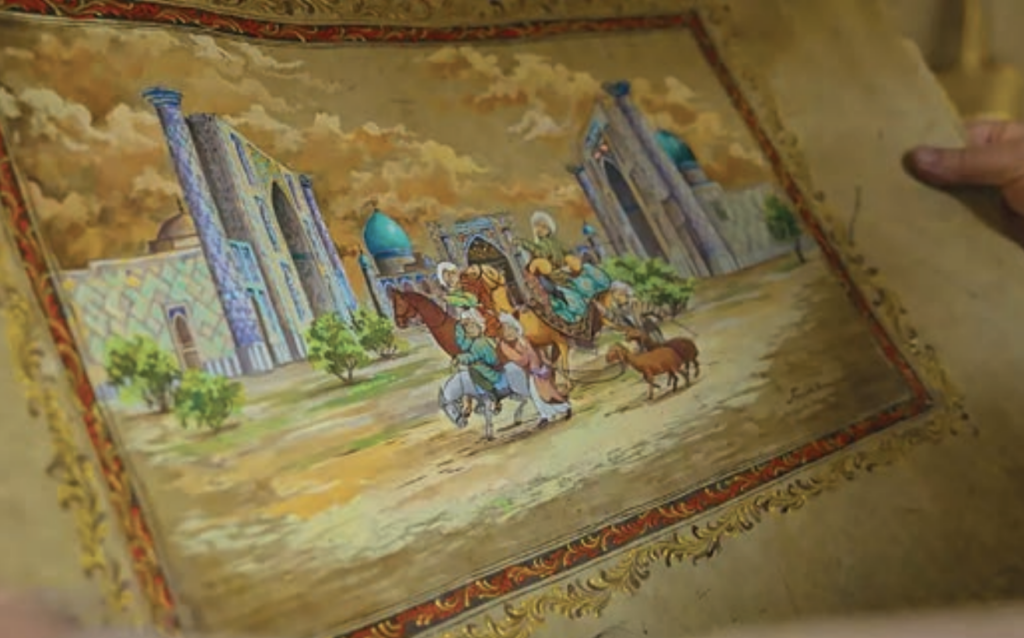
Alongside this, the natural fibers of the mulberry tree offered the paper a subtle sheen, one that made any piece of calligraphy or art look especially luxurious. It was the equivalent of writing on silk itself. Historical paintings using this material give off a natural glow, still shining through even after all these years.
The Mill
Meros Paper Mill sits about 6 miles outside Samarkand in the village of Koni Ghil beside the Siab River. You hear it before you see it. As you enter the area, there is a low, rhythmic thudding throughout the day. A wooden waterwheel turns thanks to the power of the flowing water in the river, its motion transferred through a shaft to heavy wooden mallets inside a stone building, each rising and falling over its own mortar.
The process starts with young mulberry branches, cut in winter. After soaking, the outer bark is stripped away in long ribbons using a knife. It is then dried and pressed into cardboard. What is left underneath is the bast: pale, silky strips that peel away cleanly. Those go into iron pots to boil for four or five hours until the fibers completely soften. Then they go into the mortars under the mallets where they are pounded for hours into a fine, smooth pulp.
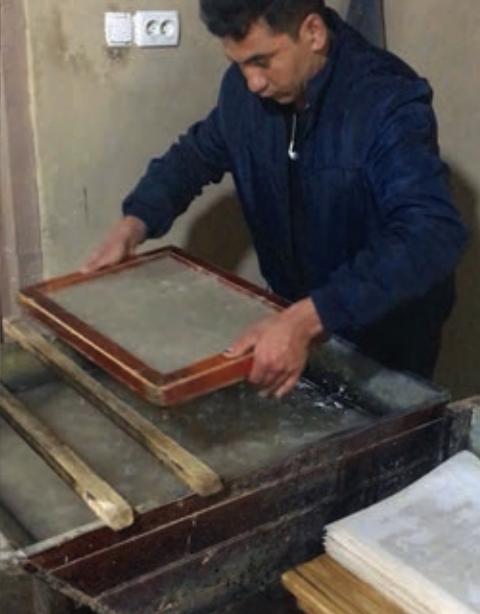
The pulp then gets transferred to a wide shallow basin of water. A craftsman lowers a wooden-framed screen into it, lifts it out horizontally, and the fibers settle across the mesh in a thin even layer – one sheet’s worth. The craftsman leaves it on a wooden plank while the water drains. Eventually he flips it onto cloth, covers it with another piece of cloth, and stacks the next sheet on top. The pile gets pressed under heavy stones for the better part of a day. The total duration of the pressing depends upon the local weather.
Once dry enough, the sheets come off the cloth and get fixed to glass panels with a wet brush. Then comes the step that makes it Samarkand paper. A craftsman called a mukrakash (master polisher) lays each sheet on a table and scrapes it with a seashell or animal horn in quick, light strokes. He does this for 30 seconds, maybe less. What was slightly textured becomes completely smooth, almost sleek. A brush does not catch on it. Ink goes where you put it and stays there. The sweeping curves that Arabic calligraphy requires land cleanly without bleeding, without blotching.
Color
Natural Samarkand paper is cream, but historically, a lot of what came out of these workshops was dyed. Calligraphers of old recommended tinted paper partly because white paper was thought to strain the eyes. Reds came mainly from the pomegranate rind. Blues came from indigo. Yellows from saffron and turmeric.
Color also served an aesthetic purpose beyond simple legibility. A tinted page created visual harmony between the ink and the paper itself. Gold leaf, for example, stood out against darker backgrounds. Lighter colors on the other end of the color spectrum might take on a stronger presence against light shades. In many manuscripts, the color of the paper was chosen deliberately to complement the style of writing and the decorative motifs used.
Lost Then Found
By the late 18th century, the workshops were mostly gone due to regional conflict, then Russian imperial control, then the appearance of cheap factory paper from Russia. The craft died within a generation.
The revival is recent. Samarkand brothers Zarif and Islam Mukhtarov became interested in the original process in the 1990s and spent years reconstructing it from historical sources. Their family opened Meros Paper Mill in Koni Ghil on land where workshops are believed to have stood centuries earlier. The mill now supplies paper for manuscript restoration projects across Uzbekistan and beyond including conservation work in Japan. Even the Chinese, the originators of mass produced paper, find themselves returning to the old trade.
The Feel of Paper
I picked up a finished sheet of traditionally manufactured paper at the end of my visit to Samarkand. It looked warm and had a distinct cream color. It was light but not fragile. But the surface was the highlight: smooth in a way that does not feel manufactured. Not waxy, not cold – like a high quality silk scarf. When you hold it in your hands, it is easy to understand why ancient calligraphers hoarded. A brush moving across it does not fight the page at all. The ink goes exactly where you send it.
The mill produces around a hundred sheets a day. In the medieval city, there were said to be 42 workshops running. That scale is gone. But the river still turns the wheel, the mallet still falls, and the mulberry still gives up its fibers to those patient enough to ask.
As I walked out of the mill, I asked the manager Sanjar Muxtorov why it’s so important to continue this legacy. Why not just use the factory cut paper and be done with it? He reaches out to grab my phone and speaks some words in Uzbek as he can only express in his native tongue the sheer relevance of this art. I look at the screen to see what the translator has formed from his words:
“Alloh taqdirimizni yozgan, demak yozish Allohga xos. Qog’oz ham yozish uchun.”
“Allah writes our destiny so writing is for Allah. But since we cannot write our destiny he has given us paper.”
Nawal Ali is a public health graduate from Chicago with a background in development. She is currently researching Islamic culture in Central Asia.
Want more like this? Subscribe to the Islamic Horizons magazine and support authentic journalism by Muslims for Muslims.