A Look Into Jeem Fitness
By Ammarah Ahmed
May/Jun 26
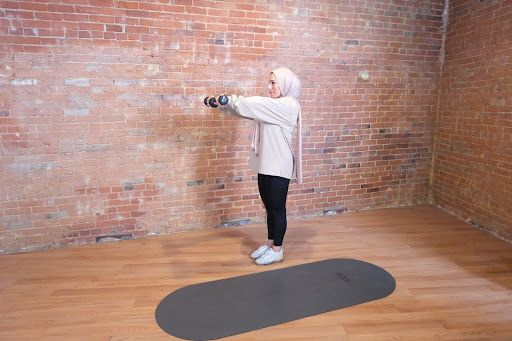
The pursuit of health and fitness has created a culture with its own aesthetics and values. Scroll through any major fitness platform and the message is the same: health is visual, strength is performative. Progress is measured not only by what you can do, but by what you’re willing to show for it.
For many women, that world can feel motivating. But for many Muslim women, it often feels like an unfavorable compromise.
Mainstream fitness culture is rarely culturally conscious. It’s built around mixed environments and a relentless obsession with displaying bodies. Even when the marketing claims empowerment, the underlying expectation is clear: if you want to take fitness seriously, you may have to leave your comfort – and sometimes your values – behind.
The founder of Jeem Fitness refused to accept that bargain.
“We are constantly surrounded by a narrative that equates health and fitness with showing skin and conforming to Western standards of beauty, fitness, and nutrition,” said Jeem Fitness co-founder Dhuha Baig. “Why is it that almost all fitness content considered authoritative requires bodies to be on display?”
It’s a question that cuts to the heart of why Jeem exists. Baig said the platform, an at-home fitness and wellness app designed specifically for Muslim women, is not trying to fit into the wellness industry as it currently stands. It’s trying to change what wellness can look like altogether by prioritizing privacy, women-only spaces, faith-aligned coaching, and a deeply intentional approach to health.
In other words, Jeem Fitness is building a safe space for health-conscious Muslim women.
A Product Built Out of Necessity
The story of Jeem Fitness, founded in 2024, begins in a familiar place to many women: the bustle of everyday life. The founders, Baig, Sana Mahmood, and Deena Farrukh are Muslim women, mothers, and professionals, living the exact reality their platform now serves.
“Between work, kids, and caregiving, getting out of the house at a fixed time can feel impossible,” Baig said. For many women, fitness becomes another rigid obligation that adds stress rather than relieving it.
The Jeem founders tried fitness apps, weight loss plans, and popular online programs, but nothing fully fit their needs. “Using them meant sacrificing values that mattered deeply to us. Immodesty, explicit music, and the lack of women-only spaces seemed to be part of the trade-off,” Baig said.
At some point, the trade-off stopped feeling like a minor inconvenience and started feeling like a structural problem.
“We realized that if we were experiencing this tension, so were many other women,” Baig said. “Why should we have to compromise our values just to move our bodies?”
That simple question sparked the creation of Jeem.
What Jeem Offers
Once users sign up via the website or on the app, they can work out in two different ways: through live virtual classes or through on-demand guided programs.
“Jeem has helped me incorporate fitness and healthy lifestyle choices back into my life,” said Jeem community member Faria. “Having the ability to take live and on-demand classes with certified instructors has given me the encouragement to resume a lifestyle of exercise and healthy habits from the comfort of my home.”
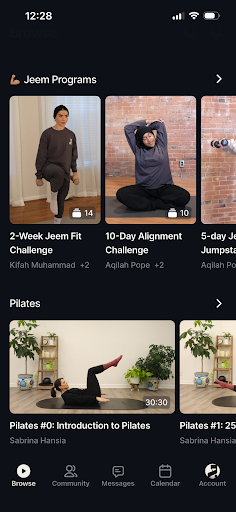
The on-demand option offers flexibility and structured programs that women can follow at their own pace without feeling like they are improvising their health journey. But it’s Jeem’s live classes that have become one of the app’s biggest features, because they offer something most at-home fitness apps fail to provide: accountability that feels personal.
Jeem’s live classes use two-way camera functionality through which trainers can see participants, correct form, and encourage them in real time.
“Accountability with two-way camera live classes is huge,” Baig said. “Trainers see you, support your form, and cheer you on.”
Jeem is designed with Muslim women in mind, and the environment reflects that with features such as modestly-dressed trainers, strictly women-only space, and a deliberate effort to remove elements that make many Muslim women uncomfortable.
Workouts are free from vulgar music and members can even select a “no music” filter. Educational content includes faith-aligned guidance, women’s health resources, and programming tailored for seasons like Ramadan.
“What we hear from users is that this matters more than they expected. What sets Jeem apart isn’t just what we provide, but who provides it,” Baig said.
Jeem’s team includes certified female instructors and educational partners with expertise spanning fitness, nutrition, mental health, and women’s wellness. The founders described the platform as a one-stop destination for holistic health.
For many women, that sense of wholeness in being able to pursue health without splitting themselves into different versions becomes one of the most healing aspects of the platform.
Mahnoor, another Jeem member, spoke of her experience joining the community. “With Jeem I have been able to challenge myself to show up and take care of my body,” she said. “The coaches are so wonderful to work with because they give me real-time feedback and they are so approachable.”
The Promise of Privacy
“Privacy is always top of mind for our team,” Baig said, “because we believe in the amanah [trust] of taking care of our users, meeting their expectations, and maintaining their trust.”
During the platform’s earliest months, women could only subscribe after completing a mandatory welcome call with the founders. The call served two purposes; it helped maintain women-only space and it gave founders direct insight into what Muslim women actually wanted from the platform.
“We had hundreds of conversations,” Baig recalled. “We were able to connect and get live feedback from the very women we were building a product for.”
As Jeem grew, the onboarding process was streamlined with ID verification through an intake form. Live classes are gated, and users must preregister so the team knows who to expect. Cameras are required, sessions are monitored, and names are cross-checked.
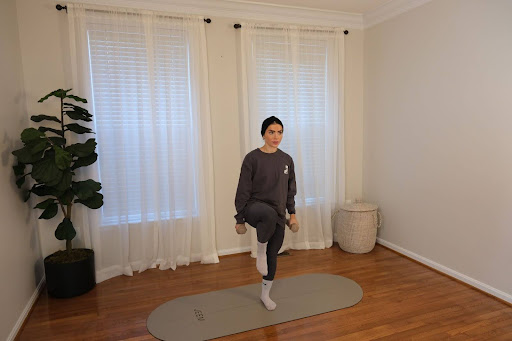
Jeem’s workouts are designed to be approachable and effective, requiring minimal space and equipment. “There is no expectation for perfection. We emphasize consistency over intensity,” Baig said. This approach helps build holistic strength.
Undoing the Damage of Mainstream Fitness Culture
Jeem is also positioned against the toxic messaging that dominates the wellness space. “We focus on strength, functionality, and how movements feel rather than simple appearance goals,” Baig said. “Our language avoids shame and comparison to undo the damage of toxic diet culture.”
The platform is also expanding its mental health content, including plans for partnerships with Muslim-led mental health wellness organizations.
“As part of my journey toward a healthier lifestyle, I was searching for a supportive, all-female fitness community where I could begin at my own pace,” said Jeem user Shabana. “Jeem has been exactly that. . . I feel stronger, more consistent, and connected to a community of women like me.”
Looking Ahead
Baig said there is a shift in mainstream fitness culture as more platforms are recognizing the need for diversity and women-only spaces. “Mainstream brands are validating the demand, but they aren’t serving them deeply,” she said.
Jeem’s founders believe that the future of inclusive fitness will not be led by companies trying to appeal to everyone. It will be led by platforms willing to serve communities deeply and intentionally, with cultural fluency and trust.
“We’re built by and for Muslim women,” Dhuha said. “We are going to shape the fitness industry into something that works for us. We are no longer willing to bend to fit into the existing mold that does not honor our faith, our values, or our genetic makeup.”
Jeem founders described what they hope women feel when they download Jeem for the first time. “To women who first open Jeem, I want to say welcome. Oftentimes the step required of us to arrive at this point is crossing a canyon. You scaled obstacles seen and unseen,” Baig said.
The platform now includes 15 trainers certified in strength training, pilates, mobility, kickboxing, and yoga along with culturally-resonant health care partners.
Muslim women interested in joining the Jeem community can visit their website or download the app from the Apple App Store or Google Play Store.
Ammarah Ahmed is a Muslim-American journalist covering a wide range of topics spanning from Islamic identity to business, law, and politics. She has written articles that highlight the impactful work of Muslims across the globe. She also holds an LL.M. from SOAS, University of London, where she studied International Law, Human Rights Law, and Islamic Law.
Want more like this? Subscribe to the Islamic Horizons magazine and support authentic journalism by Muslims for Muslims.