Where Children Learn to Lead
By Abu Batool Abdullah
Mar/Apr 26
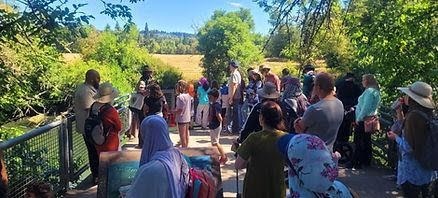
Each generation is shaped by the places where its children learn who they are. Some schools teach facts. Some teach skills. A rare few teach belonging, responsibility, and purpose. The Irvine, Calif.-based Art and Wilderness Institute (AWI) is one of those rare places. AWI stands not merely as an educational program but as a living example of what is possible when learning is rooted in nature, ethics, creativity, and community. What began six years ago as a small, faith-inspired experiment has grown into a thriving model of education — one that families trust, children love, and communities are eager to replicate.
A Place Where Education Comes to Life
Families who send their children to AWI often say the same thing, “My child comes home calmer, more confident, and more curious.” That is not an accident. AWI’s programs are built on a simple but powerful idea: children learn best when they feel connected to the earth, to their community, and to themselves. Whether in forests, gardens, parks, or in classrooms (without walls), AWI students learn by doing, exploring, questioning, and ultimately, by caring.
From early childhood programs like the Emerald Owl Preschool and Kindergarten, to middle and high school initiatives, children are taught to observe the natural world, solve real problems, and imagine sustainable futures. Education is not rushed. Curiosity is not punished. Leadership is nurtured gently and intentionally. And the results of this approach are becoming evident. This year alone, AWI expanded Emerald Owl to meet growing demand. They now offer programs twice weekly – clear proof that families are seeking an alternative to conventional, high stakes, and high-pressure early education.
Raising Leaders, Not Just Students
One of AWI’s most powerful contributions is its commitment to leadership — not from a position of authority, but one of service. The Outdoor Leadership Intensive trains young adults and educators from across the country on how to design, manage, and sustain outdoor education programs. Graduates often return to their communities to start hiking groups, environmental clubs, and/or youth programs of their own. This is the AWI ripple effect, and it is intentional.
But AWI does not want to be the only place where this kind of education exists. It wants to be a seed — a model that other states, schools, and communities can adapt and grow. What children learn here is meant to travel with them.
Faith, Justice, and Care for the Earth
Families often ask, “Can children learn science, ethics, and faith together without conflict?” AWI’s answer is an enthusiastic “yes.” Programs like the Green Masjid Initiative show how environmental stewardship can be deeply rooted in spiritual values without exclusion, politics, or dogma. Through webinars, eco-art contests, and nationwide engagement, children and families learn that caring for the planet is not optional; it is a moral responsibility.
In 2025, AWI began developing a comprehensive Environmental Justice curriculum that weaves together ecology, social equity, and collective responsibility. This curriculum will shape all future programming, ensuring that children understand not only how ecosystems work, but who is most affected when they fail and why care for the planet must be shared equally by all.
Learning That Serves the World
What makes AWI especially compelling for Muslim families is that learning does not end at understanding — it moves naturally into service. AWI students have restored fire-damaged land in California after devastating wildfires and have transformed polluted ground near Shifa Clinic into a thriving vegetable garden that now feeds clinic patients. Collectively, they’ve led hundreds of senior citizens on guided hikes, bridging generations through movement and conversation. They have helped to build libraries in Palestine’s West Bank and in Chiapas, Mexico.
These acts were not symbolic gestures. They were student-led, real-world projects, the product of the holistic education provided by AWI. As evidenced, their students grow up knowing that their hands and ideas matter, and that their actions can heal places and people.
A Community That Makes Education Accessible
One of AWI’s quiet strengths is its insistence that access should never be a barrier. In 2025 alone, over 4,000 community members participated in AWI programs, 2,300 individuals received free or volunteer-supported programming, 700 students enrolled in their educational offerings, and several scholarships ensured that families of all backgrounds could participate.
AWI is community-built and community-led. Fundraisers, pop-up events, and local partnerships make it possible for children to learn together regardless of income. This is not charity. It is a collective investment in the next generation.
A Model Worth Replicating
AWI’s expansion into Northern California in 2025 signals something important: this model works. Programs in permaculture, art, and traditional skills are already taking root in new regions. Partnerships with farms, colleges, clinics, and schools continue to grow. Families visiting AWI often say, “We wish something like this existed when we were children.” Today, it does. And what’s more – the AWI model can exist anywhere. AWI proves that education can be academically serious, spiritually grounded, environmentally responsible, emotionally nurturing, and socially just all at once.
If you are a parent wondering where your child can learn confidence without competition, develop leadership without ego, understand faith without fear, love the earth without despair, and grow into service without burnout, then AWI is not just a program, it is a path. The children who pass through this institute are not being prepared only for exams or careers. They are being prepared for life — with resilience, humility, creativity, and care. As one parent said, “AWI didn’t just teach my child. It reminded our whole family what education can be.”
This is a success story worth emulating, and one worth joining. And most importantly, it is one worth passing on to the next generation.
Abu Batool Abdullah is a freelance writer.